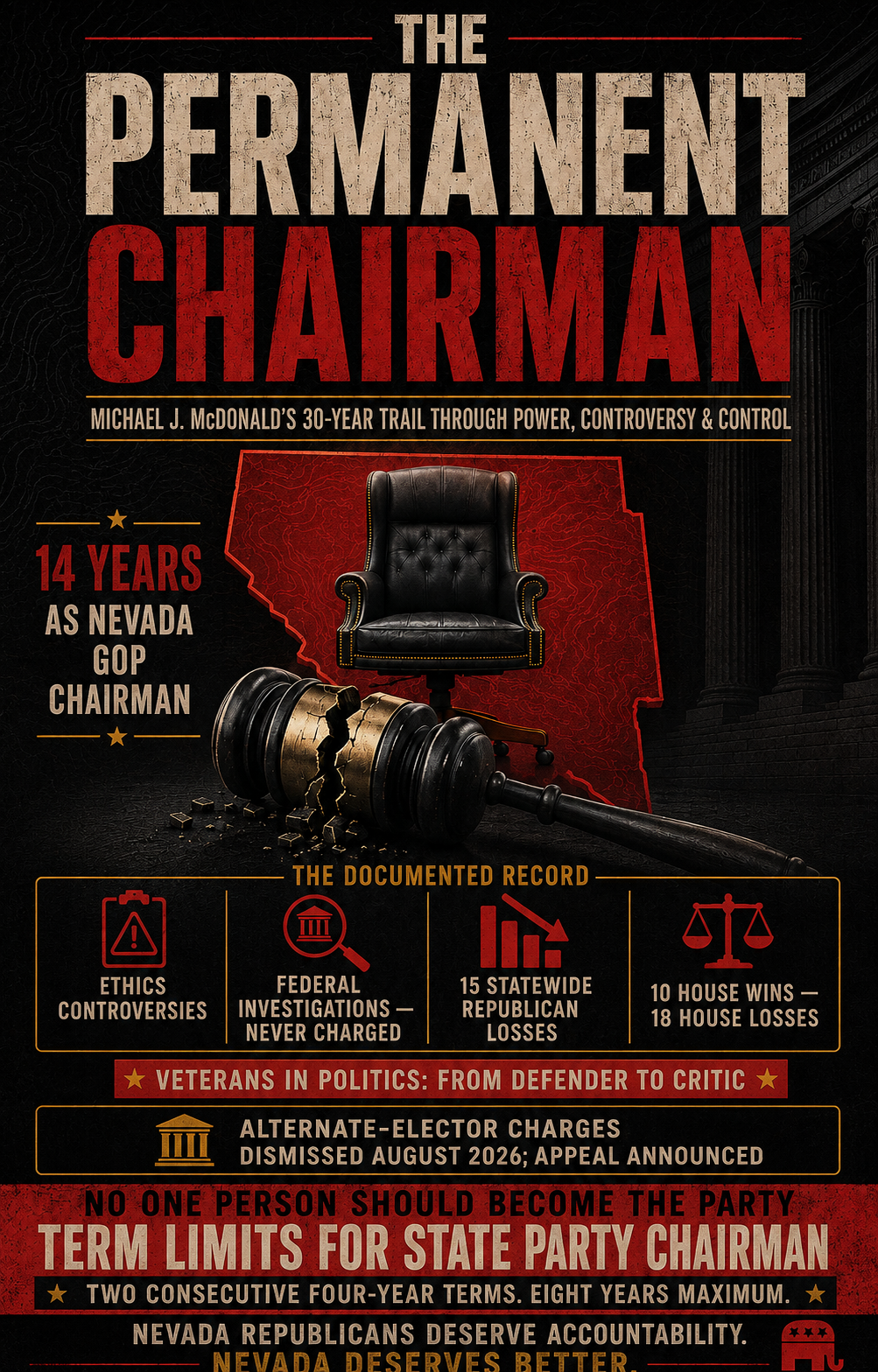
FOURTEEN YEARS OF POWER, FIFTEEN STATEWIDE LOSSES, EIGHTEEN CONGRESSIONAL DEFEATS—AND A PARTY THAT STILL REFUSES TO CHANGE
State of Nevada
MICHAEL J. McDONALD’S THREE-DECADE TRAIL THROUGH POWER, ETHICS CONTROVERSIES, STRIP-CLUB INVESTIGATIONS, PARTY WARFARE, ELECTION LOSSES AND THE NEVADA GOP MACHINE
There are politicians who come and go.
There are politicians who lose elections and disappear.
And then there is Michael J. McDonald.
For roughly three decades, McDonald has managed something unusual even by Nevada political standards: surviving controversy after controversy, investigation after investigation, intraparty rebellion after intraparty rebellion—and repeatedly emerging with another title, another political relationship and another seat near the center of power.
Police officer. Las Vegas councilman. Mayor pro tem. Lobbyist. Political consultant. State government employee. Nevada Republican Party chairman. Trump confidant. Republican National Committee official.
The offices change.
Michael McDonald remains.
That longevity is either evidence of extraordinary political resilience, as his supporters would argue, or evidence that Nevada Republican politics has developed an extraordinary tolerance for controversy.
McDonald’s record contains plenty of it.
This article does not treat every accusation as proven. It distinguishes between documented ethics findings, reported allegations, criminal investigations that did not produce charges, criminal charges that were dismissed, and political criticism. Those distinctions matter.
But fairness does not require silence.
The documented record is more than enough to justify a serious public debate about accountability, election performance and term limits for the chairman of the Nevada Republican Party.
FROM METRO TO CITY HALL
McDonald’s political biography says he joined the Las Vegas Metropolitan Police Department in 1989. A few years later, he entered Las Vegas politics and won the Ward 1 City Council seat in 1995 at age 30.
His supporters marketed him as an intensely hands-on neighborhood representative—the “Pothole Councilman.” He quickly became mayor pro tem and an influential force inside City Hall.
But the young councilman’s rise produced something else just as quickly:
Controversy over how he used political power.
McDonald became associated with efforts to build a council voting bloc so formidable that he acquired the nickname “Shadow Mayor.” Reporting surrounding the council’s 1999 expansion described McDonald pushing for Lawrence Weekly and Orlando Sanchez to fill new seats. Had both men been appointed, McDonald and his allies potentially would have controlled four council votes. Mayor Oscar Goodman helped block that configuration.
That was the beginning of one of the strangest political relationships in Las Vegas history.
MICHAEL McDONALD VS. OSCAR GOODMAN
McDonald and Mayor Oscar Goodman were not always political allies.
Far from it.
Their battles became deeply personal during the turbulent politics surrounding City Hall and proposals to reconsider the city’s relationship with Metro.
McDonald secretly recorded a conversation with Goodman, an episode Nevada political journalists continued referencing years later when discussing Nevada recording law.
Then came the recall movement.
Former Councilman Steve Miller organized an effort to recall McDonald. Archived contemporary accounts document that Goodman signed a Recall McDonald petition in November 2000 after a bitter public falling-out.
Yet politics makes strange alliances.
By McDonald’s 2003 reelection campaign, Goodman had reversed course and endorsed the councilman he previously supported recalling.
That reversal became an early example of a theme that would follow McDonald for decades:
Yesterday’s enemy can become tomorrow’s ally when political survival demands it.
THE ETHICS RECORD IS NOT POLITICAL FOLKLORE
Some attacks on politicians amount to rumor.
McDonald’s ethics history does not.
There are actual Nevada ethics proceedings and reported findings.
In a matter involving the proposed Ranger Building, the Nevada Ethics Commission found that McDonald exercised poor judgment and violated city protocol by becoming involved after recusing himself. The commission did not sustain every statutory allegation presented in that matter, which is an important distinction.
Another case was more damaging.
McDonald faced scrutiny over his involvement in the Las Vegas Sportspark, a project connected with Larry Scheffler, McDonald’s private employer at Las Vegas Color Graphics. Contemporary reporting said the Nevada Ethics Commission unanimously found violations of two subsections of state ethics law. Other reporting described the state body’s conclusion as unethical but not willful, while the Las Vegas Ethics Review Board concluded that McDonald’s conduct was intentional and referred the matter for possible prosecution.
Different ethics bodies reached different conclusions about intent and remedies.
But the central point remains:
McDonald’s ethics problems were not invented years later by political opponents. They were examined by official bodies while he held public office.
McDonald’s political career nevertheless continued.
THEN CAME OPERATION G-STING
If McDonald’s ethics problems were serious, the federal corruption investigation that exploded across Southern Nevada in the early 2000s was catastrophic for the political establishment surrounding him.
The FBI investigation eventually known as Operation G-Sting centered on strip-club owner Michael Galardi and political corruption involving local officials.
McDonald acknowledged working as a land-development and zoning consultant for Galardi. During the investigation, federal authorities sought records concerning payments or gifts involving McDonald and other officials. McDonald’s attorney said he received an FBI letter identifying him as a “subject” of the probe.
Reporting later disclosed that the FBI wiretapped McDonald’s telephone during the investigation.
McDonald also had professional ties to Rick Rizzolo, owner of the Crazy Horse Too strip club, another notorious figure in Las Vegas nightlife and law-enforcement history. Later reporting described authorities as examining McDonald’s dealings with both Galardi and Rizzolo.
At related proceedings, Galardi made highly damaging allegations about payments and political influence involving McDonald. Allegations from a cooperating witness—especially one seeking favorable treatment—are not the same as a criminal conviction. They should be described as allegations, not established facts.
Here is the crucial fact that every legitimate article must include:
MICHAEL McDONALD WAS NEVER CRIMINALLY CHARGED OR CONVICTED IN CONNECTION WITH OPERATION G-STING.
That distinction matters.
Several other politicians and figures connected with the sprawling investigation were not so fortunate. Public officials and Galardi entered the criminal justice system. McDonald did not.
The absence of charges does not erase the existence of the investigation, the wiretap, his consulting relationships or the political damage. It does mean nobody should falsely state that McDonald was convicted—or even indicted—in the G-Sting case.
THE LATER TAX INVESTIGATION
The scrutiny did not end with G-Sting.
In 2007, the Las Vegas Review-Journal reported that federal authorities were pursuing a tax investigation involving McDonald’s finances. The newspaper reported that investigators were examining whether income had been properly reported and revisited his consulting activities while in office.
Again, the outcome matters:
McDonald was not criminally charged in that tax investigation.
The responsible conclusion is neither “nothing happened” nor “he was guilty.” The responsible conclusion is that federal scrutiny followed McDonald beyond the original corruption investigation, but prosecutors did not bring a criminal case against him.
THE VOTERS FINALLY FIRED HIM
On June 3, 2003, Ward 1 voters ended McDonald’s City Hall career.
Political newcomer Janet Moncrief defeated him 58 percent to 42 percent—4,773 votes to 3,455.
McDonald’s campaign manager acknowledged that the federal investigation devastated the campaign. McDonald was seeking another council term only weeks after acknowledging his consulting work for Galardi.
For many politicians, that would have been the end.
For McDonald, it became an intermission.
REINVENTION: LOBBYIST, CONSULTANT AND GOVERNMENT EMPLOYEE
After City Hall, McDonald reinvented himself through lobbying, consulting and development.
His company, Alpha-Omega Strategies, became involved in a variety of business interests. Lobbying records showed an eclectic list of clients, including attorney Glen Lerner, the Armenian American Cultural Society, the Laughlin Constable’s Office, the Southern Nevada Rural Constable’s Alliance and—even for a future Republican Party chairman—the Culinary Workers Union Local 226.
There is nothing inherently improper about legally registered lobbying.
But McDonald’s post-council career demonstrates how easily political relationships can be converted into professional influence.
THE DEPUTY TREASURER JOB
In 2015, Republican State Treasurer Dan Schwartz hired McDonald as a senior deputy treasurer at an annual salary reported to be approximately $95,000.
The appointment immediately generated criticism because of McDonald’s relationship with Schwartz, a former Nevada GOP finance director, and because critics questioned McDonald’s qualifications for the role.
McDonald resigned within roughly three months.
Supporters can characterize that as an ordinary personnel decision. Critics can call it political patronage.
Either way, the episode ended almost as quickly as it began.
THE DENTAL BOARD CONTRACT
Then came the Nevada State Board of Dental Examiners.
The board hired McDonald and Alpha-Omega Strategies as its lobbyist and legislative liaison under a two-year, $72,000 contract despite his lack of apparent experience in dentistry, health care or occupational licensing boards.
A Nevada Independent public-records investigation later reported that available records reflected limited documented work during portions of the contract and raised questions about what taxpayers or licensees received for the money.
The reporting did not establish that McDonald committed a crime.
It did establish another legitimate accountability question:
Why did a regulatory board select a politically connected party chairman without relevant subject-matter experience, and what measurable work did he perform?
Different decade.
Different institution.
Same Michael McDonald.
THE CHAIRMAN WHO WOULD NOT LEAVE
McDonald’s greatest political resurrection came in 2012, when he was elected chairman of the Nevada Republican Party.
He has remained there ever since.
In 2013, Republican Gov. Brian Sandoval, U.S. Sen. Dean Heller and other prominent Republicans backed Robert Uithoven in an attempt to replace McDonald.
They failed.
Grassroots members reelected McDonald.
Another challenge came in 2015.
McDonald survived that too.
He won what the party called a historic fifth term in 2019 with 57 percent of the first-ballot vote.
He was elected again in July 2025. The Nevada GOP described him as the longest-serving state Republican chairman in the nation.
This is no temporary chairmanship.
It is an institution.
The party’s bylaws identify the chairman as its chief executive officer. They give the chairman authority to preside over the central committee and executive committee, appoint standing-committee chairs subject to executive-committee approval, help manage party policy and serve on the Republican National Committee.
Those are substantial powers even when held for one term.
After fourteen years under the same person, they also create an unavoidable question:
WHERE DOES PARTY LEADERSHIP END AND A PERSONAL POLITICAL MACHINE BEGIN?
FROM DEFENDER TO CRITIC: VETERANS IN POLITICS SPEAKS OUT
This criticism does not come from people who always opposed Michael McDonald.
For years, Veterans In Politics International and its president, Steve Sanson, stood beside him. According to Sanson and the organization’s institutional account, Veterans In Politics supported McDonald during efforts to recall him from the Las Vegas City Council; supported McDonald and Councilwoman Lois Tarkanian in their effort to prevent the closure of the Garside Post Office; and continued supporting him through the political battles surrounding his 2003 Ward 1 reelection campaign.
The timeline requires one correction for historical accuracy. The recall effort against McDonald occurred earlier and did not remove him. Janet Moncrief defeated him in the regular 2003 municipal election—not in a successful recall election. Contemporary reporting later documented that Bob Stupak, the original owner of the Stratosphere, paid a consultant in cash and casino chips to assist Moncrief’s successful campaign.
Veterans In Politics also supported McDonald during Operation G-Sting, when he was investigated but never charged. The organization endorsed him for state party chairman in 2012, 2013, 2015, 2017, 2019, 2021, 2023 and 2025. It supported his bylaw changes, amendments and adoptions, advocated changing state officer terms from two years to four years, and aligned with him during attempted party takeovers and the Ron Paul movement.
Veterans In Politics Talk interview—“Michael McDonald Nevada Republican Party Chairman Speaks His Mind on the Veterans In Politics Talk”:
https://www.youtube.com/watch?v=6U0mImo0MBo&t=1681s
Veterans In Politics endorsement—“Michael McDonald, Nevada Republican Party State Chairman, Is Endorsed by Veterans In Politics”:
https://www.youtube.com/watch?v=4iqrHOFs-QM&t=9s
Sanson says he and his organization were proud to call McDonald a friend.
That history makes the break more significant.
Sanson says Veterans In Politics repeatedly offered McDonald proposals to unify the party, broaden participation and bring greater diversity into Republican politics. In Sanson’s judgment, McDonald appeared to listen but did not take those proposals seriously. Sanson argues that McDonald’s leadership has discouraged Republicans from joining, while removals and internal loyalty battles have narrowed the active organization to a smaller circle of committed McDonald allies.
That is Sanson’s political assessment, not a proven statement of McDonald’s intent. But it comes from a former ally who supported McDonald for years—not from a lifelong adversary.
THE SILVERTON VOTE: A FIRSTHAND ACCOUNT
Sanson also describes a confrontation at a Nevada Republican Party meeting at the Silverton as the moment the relationship became impossible to ignore.
According to Sanson’s firsthand account, Silverton security officers and Las Vegas Metropolitan Police Department officers detained him outside the venue after former congressional candidate Ronda Kennedy accused him of battering a member of her team and claimed video footage existed. Sanson denies the allegation and describes it as false. No video footage was made available.
While Sanson remained outside, he says Kennedy made a motion on the meeting floor to remove him and Stephanie Phillips—Veterans In Politics International’s political director and a co-host of its talk show—from the state party because Veterans In Politics endorses candidates from more than one political party.
Sanson says the vice chairman asked Kennedy to cite the bylaw authorizing such a removal. According to his account, Kennedy could not identify it, was given time to search, returned to the microphone and again said she could not locate it. The body nevertheless voted on the motion. According to Sanson, the “nay” vote—to keep both Sanson and Phillips in the GOP—unanimously defeated the “yea” vote to remove them, even though bringing the motion forward was itself contrary to the party’s bylaws.
Sanson’s position is that the vote should never have occurred: neither he nor Phillips held a seat on a partisan political board; both are members of the Republican Party; and no bylaw was identified that prohibited their involvement with a nonpartisan endorsement organization. He says Clark County Republican Chairwoman Jill Douglass was the only senior party leader who defended them against the motion and that McDonald did not intervene.
Sanson believes McDonald may have known about—or helped orchestrate—the effort to remove them. He does not claim to possess conclusive proof of McDonald’s role. This article therefore presents that assertion as Sanson’s belief, not as an established fact. The article likewise does not claim that an official proceeding adjudicated every disputed detail of the alleged battery or the floor vote.
What is established by Sanson’s account is the depth of his disillusionment. After years of defending McDonald, endorsing him and standing with him during party rebellions, he says McDonald repeatedly misled him and would not defend him or Phillips when the rules themselves appeared to be in question.
A “BIG TENT”—UNTIL THE TENT ERUPTS
Critics of McDonald’s Nevada GOP frequently describe a culture of loyalty tests, internal warfare and institutional control.
The broadest allegation—that McDonald personally expels anyone he dislikes—goes further than the public evidence permits as a blanket statement.
But there is ample evidence of brutal internal struggles over who gets seated, recognized, censured or removed.
In 2021, the party descended into warfare involving competing Clark County Republican factions, disputes over central-committee membership and allegations involving Proud Boys activists.
McDonald defended the organization by insisting that Nevada’s GOP was a “big tent,” that properly elected Republicans should be allowed to participate and that members could be removed only for cause by vote.
McDonald also denied recruiting Proud Boys members to influence the censure of Secretary of State Barbara Cegavske and said he did not condone hateful messages.
Those denials belong in the record.
So does what happened around him.
The state committee approved motions to remove multiple people from the state central committee “for cause,” including former Assemblyman Stephen Silberkraus, amid the Clark County factional war.
Competing county factions went to court. Reporting described McDonald recognizing the faction led by ally Jesse Law after rival county leaders disputed that faction’s election.
This does not prove McDonald personally orchestrated every removal or conflict.
It establishes something broader:
Nevada Republican politics during his chairmanship has repeatedly been characterized by ferocious fights over credentials, recognition, membership and control.
BARBARA CEGAVSKE: LOYALTY VERSUS ELECTION REALITY
Perhaps the clearest example of the Nevada GOP turning on one of its own came after the 2020 election.
Republican Secretary of State Barbara Cegavske investigated allegations of widespread election fraud.
She did not produce the answer Trump allies wanted.
Her office found no credible evidence supporting allegations of widespread fraud sufficient to overturn Nevada’s certified election result.
The Nevada Republican Central Committee responded by censuring her in April 2021.
McDonald left the dais during the debate and later emphasized that the resolution came from the floor and that he did not personally control the vote.
That defense deserves inclusion.
But the political message transmitted by the organization he chaired was unmistakable:
A Republican statewide constitutional officer investigated election claims, rejected claims she could not substantiate—and her own party censured her.
That episode speaks volumes about what dissent can cost inside a highly polarized political organization.
THE 2024 CAUCUS-PRIMARY CONFUSION
Nevada’s 2024 Republican presidential process created another controversy.
A state law required a presidential primary. The Nevada GOP nevertheless operated a separate caucus and awarded delegates through that caucus rather than the state-run primary.
Party rules barred candidates who entered the primary from competing in the caucus. Critics—including Republican presidential campaigns—argued that the arrangement confused voters and favored Donald Trump.
McDonald and the party defended the caucus as lawful, secure and consistent with party authority over delegate selection.
Trump dominated the caucus and eventually won Nevada in the general election.
But success for the preferred candidate does not erase the process question:
Did the Nevada GOP design an open competition—or a predictable result?
TRUMP CHANGED EVERYTHING FOR McDONALD
McDonald’s most important alliance has been Donald Trump.
He cultivated a close relationship with Trump, helped bring him to Nevada events and became one of Trump’s strongest state-level allies. McDonald later served as a senior Trump campaign adviser and won election as an RNC Western regional vice chair.
That loyalty elevated McDonald nationally.
It also placed him directly inside one of the most controversial episodes in modern American election history.
THE ALTERNATE-ELECTOR CASE
After Joe Biden won Nevada in 2020 by more than 30,000 votes, McDonald and five other Republicans signed a certificate purporting to cast Nevada’s electoral votes for Trump.
Nevada Attorney General Aaron Ford later brought felony charges against the six Republicans.
The case took a complicated path through Nevada courts. A trial judge initially dismissed the Clark County case on venue grounds. The Nevada Supreme Court later ruled that Clark County was a proper venue and returned the case for further proceedings.
In August 2026, District Judge Mary Kay Holthus dismissed the charges again. She concluded that prosecutors failed to establish sufficient evidence of intent to defraud and criticized prosecutors for withholding evidence from the grand jury. The attorney general announced plans to appeal.
The facts must travel together:
McDonald signed the alternate electoral certificate.
He was criminally charged.
He pleaded not guilty.
The charges were dismissed.
He has not been convicted.
An announced appeal means the litigation may not be over, but a possible future appeal is not a conviction and should never be described as one.
Anything less accurate becomes propaganda rather than journalism.
THE STATEWIDE ELECTION SCORECARD: FIFTEEN REPUBLICAN LOSSES
A party chairman does not personally control every candidate, campaign, national political wave or voter decision.
McDonald therefore cannot fairly be blamed for every Republican defeat.
But a state party exists to recruit candidates, raise money, organize volunteers, turn out voters and elect Republicans. After fourteen years, election results are part of the chairman’s record.
From McDonald’s election as chairman in 2012 through the 2024 general election, Republican nominees lost fifteen partisan statewide contests in Nevada.
Here is the documented list:
2012
1. PRESIDENT: Republican Mitt Romney lost Nevada to Democrat Barack Obama.
Republican Dean Heller won the U.S. Senate race that year.
2014
No Republican statewide losses. Republicans swept all six statewide executive offices: governor, lieutenant governor, attorney general, secretary of state, treasurer and controller.
That was an extraordinary Republican victory and belongs in any fair assessment of McDonald’s tenure.
2016
2. PRESIDENT: Republican Donald Trump lost Nevada to Democrat Hillary Clinton.
3. U.S. SENATE: Republican Joe Heck lost to Democrat Catherine Cortez Masto.
2018
4. U.S. SENATE: Republican incumbent Dean Heller lost to Democrat Jacky Rosen.
5. GOVERNOR: Republican Adam Laxalt lost to Democrat Steve Sisolak.
6. LIEUTENANT GOVERNOR: Republican Michael Roberson lost to Democrat Kate Marshall.
7. ATTORNEY GENERAL: Republican Wes Duncan lost to Democrat Aaron Ford.
8. STATE TREASURER: Republican Bob Beers lost to Democrat Zach Conine.
9. STATE CONTROLLER: Republican incumbent Ron Knecht lost to Democrat Catherine Byrne.
Republican Secretary of State Barbara Cegavske won reelection, preventing a complete Democratic sweep of statewide offices.
2020
10. PRESIDENT: Republican Donald Trump lost Nevada to Democrat Joe Biden.
2022
11. U.S. SENATE: Republican Adam Laxalt lost to Democratic incumbent Catherine Cortez Masto.
12. ATTORNEY GENERAL: Republican Sigal Chattah lost to Democratic incumbent Aaron Ford.
13. SECRETARY OF STATE: Republican Jim Marchant lost to Democrat Cisco Aguilar.
14. STATE TREASURER: Republican Michele Fiore lost to Democratic incumbent Zach Conine.
Republicans also recorded important victories. Joe Lombardo won the governorship, Stavros Anthony won lieutenant governor and Andy Matthews won controller.
2024
15. U.S. SENATE: Republican Sam Brown lost to Democratic incumbent Jacky Rosen.
Republican Donald Trump won Nevada’s presidential vote, becoming the first Republican presidential nominee to carry the state since 2004.
WHAT THE SCORECARD MEANS—AND WHAT IT DOES NOT
The number is fifteen.
Fifteen Republican losses in partisan statewide contests under McDonald through 2024.
That total is not an argument that McDonald produced no victories.
He did.
The 2014 statewide sweep was historic.
Republicans retained the secretary of state’s office in 2018.
Republicans won the governorship, lieutenant governorship and controllership in 2022.
Trump carried Nevada in 2024.
McDonald’s supporters also credit him with fundraising, year-round organization and strong relationships with the national party. His peers have repeatedly reelected him.
Those are legitimate points.
But the other side of the ledger cannot be erased:
Two Republican presidential losses before the 2024 breakthrough.
Four Republican U.S. Senate losses—in 2016, 2018, 2022 and 2024—with only the 2012 Heller victory during McDonald’s tenure.
Losses in nearly every major statewide executive office during the 2018 cycle.
Losses for attorney general, secretary of state and treasurer again in 2022.
As of 2026, Democrats hold both Nevada U.S. Senate seats, the attorney general’s office, the secretary of state’s office and the treasurer’s office.
If a football coach produced meaningful wins but also presided over fourteen seasons and fifteen statewide defeats, supporters would cite the victories.
The board would still review the complete record.
Political parties should do the same.
THE CONGRESSIONAL SCORECARD: TEN WINS, EIGHTEEN LOSSES
The federal record extends beyond presidential and U.S. Senate contests.
Nevada has four U.S. House districts. Official Nevada election results show that, from the 2012 through 2024 general elections, Republican House nominees won ten district races and lost eighteen:
2012: two wins, two losses.
2014: three wins, one loss—the party’s congressional high-water mark during McDonald’s chairmanship.
2016: one win, three losses.
2018: one win, three losses.
2020: one win, three losses.
2022: one win, three losses.
2024: one win, three losses.
Since 2016, Republican Mark Amodei’s District 2 seat has been the party’s only Nevada U.S. House victory in every general-election cycle. Democrats have won Districts 1, 3 and 4 in five consecutive general elections.
Again, a chairman does not choose the political geography of every district or personally run every campaign. Incumbency, redistricting, candidate quality, national spending and the political environment all matter. Nevertheless, a state party’s congressional performance belongs in any serious review of its chairman.
Combined with statewide results, the federal picture is mixed: Trump’s 2024 Nevada victory was historic, but Republicans have not won a Nevada U.S. Senate race since 2012 and have not won more than one of the state’s four House seats since 2014.
THE FUNDRAISING RECORD: REAL GROWTH, IMPORTANT CONTEXT
McDonald’s strongest argument is organizational and financial.
His supporters say he inherited a party that was broke and unstable, established year-round staffing beginning in 2015, developed a recurring small-dollar donor program and used his relationship with Donald Trump to host major fundraisers. In his 2019 reelection materials, McDonald claimed the party had raised more than $5 million in the preceding cycle, had not incurred debt during his tenure and had attracted approximately 2,000 grassroots donors to a small-dollar program.
Official Federal Election Commission reports for the Nevada Republican Central Committee confirm substantial growth in the committee’s federally reported receipts, although federal filings do not capture every state-party dollar and transfers from affiliated committees can make cycle-to-cycle comparisons imperfect.
The committee’s FEC two-year-cycle summaries report the following receipts and spending:
2012 CYCLE: $1,330,673.55 raised; $1,676,886.13 spent. The summary reports $1,217 in contributions to other committees, no party-coordinated expenditures and no independent expenditures.
2014 CYCLE: $379,955.78 raised; $421,339.99 spent. The summary reports no contributions to other committees, party-coordinated expenditures or independent expenditures.
2016 CYCLE: $5,774,604.23 raised; $5,649,992.78 spent. The summary reports $15,000 in contributions to other committees, no party-coordinated expenditures and no independent expenditures.
2018 CYCLE: $5,315,890.97 raised; $5,063,126.97 spent. The summary reports $10,000 in contributions to other committees, $129,150 in party-coordinated expenditures and no independent expenditures.
2020 CYCLE: $11,072,070.61 raised; $10,897,365.98 spent. The summary reports $1,204,247.52 in contributions to other committees, $98,725 in party-coordinated expenditures and no independent expenditures.
2022 CYCLE: $4,938,808.38 raised; $5,304,773.25 spent. The summary reports $16,140 in contributions to other committees, no party-coordinated expenditures and no independent expenditures.
2024 CYCLE: $11,684,166.63 raised; $11,565,016.75 spent. The summary reports no contributions to other committees, $40,000 in party-coordinated expenditures and $72,397.02 in independent expenditures.
2026 CYCLE THROUGH JULY 31, 2026: $1,971,350.82 raised; $1,707,266.22 spent. The summary reports no contributions to other committees, party-coordinated expenditures or independent expenditures.
These figures come from FEC committee C00082925. The 2012 figure covers the full 2011–2012 reporting cycle, including months before McDonald became chairman. The 2026 figure is incomplete because the cycle is still underway. The totals measure committee receipts and disbursements—not money personally raised or spent by McDonald—and include transfers, payroll, operating costs, federal election activity and other categories.
From the 2012 cycle through July 31, 2026, the committee reported $42,467,520.97 in total receipts and $42,285,768.07 in total disbursements. Total spending was therefore $181,752.90 less than total receipts—a difference of approximately 0.43 percent. At the overall committee level, the FEC summaries do not show a large unexplained gap between money raised and money spent.
But total party spending is not the same as spending directly on candidates.
Across those cycle summaries, the committee reported $267,875 in party-coordinated expenditures and $72,397.02 in independent expenditures—a combined $340,272.02 in categories unambiguously tied to supporting or opposing candidates. That equals approximately 0.80 percent of the committee’s $42.29 million in total spending.
The committee also reported $1,246,604.52 in contributions to other committees. Adding that entire category would produce $1,586,876.54, or approximately 3.75 percent of total spending. However, the FEC summary labels those payments as contributions to other committees; recipient-level records would be required before representing all of that money as direct spending on candidates.
The apparent discrepancy is therefore not primarily between the amount raised and the amount spent. Nearly all reported receipts were ultimately disbursed. The more important accountability question is how much of the party’s total spending directly supported candidates, how much moved through affiliated or other political committees, and how much paid for staffing, administration, voter programs and other party operations.
The filings also complicate the blanket claim that the party never carried debt. The FEC year-end reports examined here showed no debt in 2014, 2016, 2018 or 2020, but reported approximately $2,500 in debt at the end of 2012 and approximately $10,676 at the end of 2022. Those amounts do not erase the fundraising growth; they do require more precise language.
The fair conclusion is that the Nevada GOP’s federal financial operation became materially larger during McDonald’s tenure, especially in presidential cycles. That is a genuine accomplishment. It does not, by itself, settle whether the money produced an acceptable number of statewide, congressional or legislative victories.
TERM LIMITS FOR STATE PARTY CHAIRMAN
This debate should be larger than Michael McDonald.
The party’s officer structure has already changed. Nevada GOP bylaws used in 2015 provided two-year terms for state officers. The party’s 2025 officer-election notice quotes the current bylaw as providing a four-year term for the chairman. Veterans In Politics supported extending the term because two years can be too short to build, finance and execute a statewide strategy.
But a longer term should be paired with a firm limit.
No individual—Republican or Democrat—should control a state political party indefinitely.
State party chairmen influence money, staffing, committee appointments, credentials, messaging, candidate access, national-party relationships and internal disputes. Long tenure allows experience and relationships to accumulate. It can also discourage challengers, concentrate institutional knowledge, reward loyalty over competence and make the party dependent on one personality.
Republicans routinely support term limits for public officials because concentrated power can become self-protecting.
Why should that principle stop at the party headquarters door?
THE NEVADA REPUBLICAN PARTY SHOULD ADOPT TERM LIMITS FOR ITS CHAIRMAN.
A reasonable rule would allow no more than two consecutive four-year terms—a maximum of eight consecutive years—followed by at least one full four-year term out of office before that person could seek the chairmanship again.
The exact limit can be debated.
The principle should not be.
Eight years is enough time to build an organization, raise money, recruit candidates, train successors and demonstrate results.
If the party cannot survive without one chairman after eight years, then the chairman has not built a durable institution.
If the party can survive, leadership rotation will invite new donors, organizers, candidates, strategies and ideas.
Term limits would not erase McDonald’s accomplishments.
They would ensure that no future chairman—McDonald or anyone else—can become synonymous with the party itself.
THE REAL MICHAEL McDONALD QUESTION
Michael McDonald’s story is not that he has been convicted of every accusation thrown at him.
He has not.
It is not that every ethics allegation resulted in an adverse finding.
They did not.
It is not that every factional dispute inside the Nevada GOP was orchestrated by him.
The evidence does not establish that.
It is not that Republicans have never won during his chairmanship.
They have.
The extraordinary story is survival.
He survived ethics proceedings.
He survived the recall movement.
He survived his war with Oscar Goodman.
He survived G-Sting without being charged.
He survived a later tax investigation without being charged.
He survived losing his City Council seat.
He survived scrutiny over lobbying and government employment.
He survived establishment Republicans trying to remove him as chairman.
He survived Nevada GOP civil wars.
He survived the Cegavske catastrophe.
He survived criminal charges in the alternate-elector case—and, as of August 2026, those charges have again been dismissed.
Through all of it, he accumulated more political power rather than less.
That may be Michael McDonald’s greatest political talent.
Not ideology.
Not policy.
Not governing.
Survival.
The former Metro officer who entered Las Vegas politics in the 1990s is now the longest-serving Nevada Republican chairman in history, an RNC power player and a man whose political career has outlasted governors, senators, mayors, legislators, challengers, investigations and enemies.
Nevada Republicans therefore face questions larger than Michael McDonald himself:
Is the Nevada Republican Party an institution led by a chairman—or has the chairman become the institution?
Should one person remain in control for fourteen years when the party claims to believe in competition, accountability and limited power?
Does the complete election record—victories and fifteen statewide losses—justify another term without meaningful debate?
Why has the party failed to develop a successor capable of winning the chairmanship?
Political parties routinely preach accountability to government.
They should not be afraid to practice it inside their own walls.
Michael McDonald has survived virtually everything Nevada politics has thrown at him.
The most revealing question is no longer how he keeps surviving.
It is:
WHY HAS NOBODY IN THE NEVADA REPUBLICAN PARTY BEEN ABLE TO REPLACE HIM?
The answer may tell Nevada voters more about the modern NVGOP than anything Michael McDonald could ever say from a podium.
SELECTED SOURCES AND PUBLIC RECORDS
Nevada Secretary of State, official election results archive:
https://www.nvsos.gov/elections/election-information/previous-elections/election-results
Nevada Republican Party bylaws:
https://nevadagop.org/about-us/bylaws/
Nevada Republican Party 2025 officer-election notice confirming four-year terms:
https://nevadagop.org/wp-content/uploads/2025/05/DRAFT-2025-07-12-Notice-of-Officer-Elections.pdf
Federal Election Commission, Nevada Republican Central Committee filings (C00082925):
https://www.fec.gov/data/committee/C00082925/
Veterans In Politics Talk interview—“Michael McDonald Nevada Republican Party Chairman Speaks His Mind on the Veterans In Politics Talk”:
https://www.youtube.com/watch?v=6U0mImo0MBo&t=1681s
Veterans In Politics endorsement—“Michael McDonald, Nevada Republican Party State Chairman, Is Endorsed by Veterans In Politics”:
https://www.youtube.com/watch?v=4iqrHOFs-QM&t=9s
Nevada GOP announcement of McDonald’s fifth term:
https://nevadagop.org/nevada-gop-re-elects-chairman-michael-j-mcdonald-opts-out-of-2020-caucus/
Las Vegas Sun, state ethics findings involving the Sportspark:
https://lasvegassun.com/news/2001/feb/16/panel-rules-mcdonald-violated-ethics-laws/
Las Vegas Review-Journal, federal tax investigation and G-Sting background:
https://www.reviewjournal.com/news/tax-probe-targeting-mcdonald/
The Nevada Independent, dental-board lobbying contract:
https://thenevadaindependent.com/article/nevada-gop-chair-mcdonald-hired-as-dental-board-lobbyist-despite-lack-of-experience-in-field
The Nevada Independent, records concerning dental-board work:
https://thenevadaindependent.com/article/state-republican-party-chair-did-little-work-for-second-job-as-dental-board-lobbyist-records-show
The Nevada Independent, Cegavske censure:
https://thenevadaindependent.com/article/nevada-republicans-vote-to-censure-sos-cegavske-over-voter-fraud-allegations
The Nevada Independent, August 2026 dismissal of the alternate-elector case:
https://thenevadaindependent.com/article/clark-county-judge-dismisses-case-against-nevada-fake-electors-for-second-time
Associated Press, Nevada’s 2024 primary-caucus controversy:
https://apnews.com/article/5e762a7fff858d29f81ad90c6a6f196a