MICHAEL McDONALD’S NEVADA GOP POWER NETWORK: FOLLOW THE MONEY, FOLLOW THE INFLUENCE, AND ASK WHO REALLY CONTROLS THE PARTY!
Special Investigative Report | October 30, 2026
Six political figures. One longtime state chairman. A controversial network of political consultants, campaign organizations, party insiders, financial transactions, and criminal proceedings.
For more than 14 years, Michael McDonald has occupied one of the most influential positions in Nevada Republican politics.
First elected Nevada Republican Party chairman in April 2012, McDonald has survived internal disputes, leadership challenges, and years of disappointing Republican election results.
But the question is no longer simply how McDonald has remained chairman.
The more important question is how political influence, money, organizational relationships, and voting power circulate through the Nevada Republican Party—and who benefits.
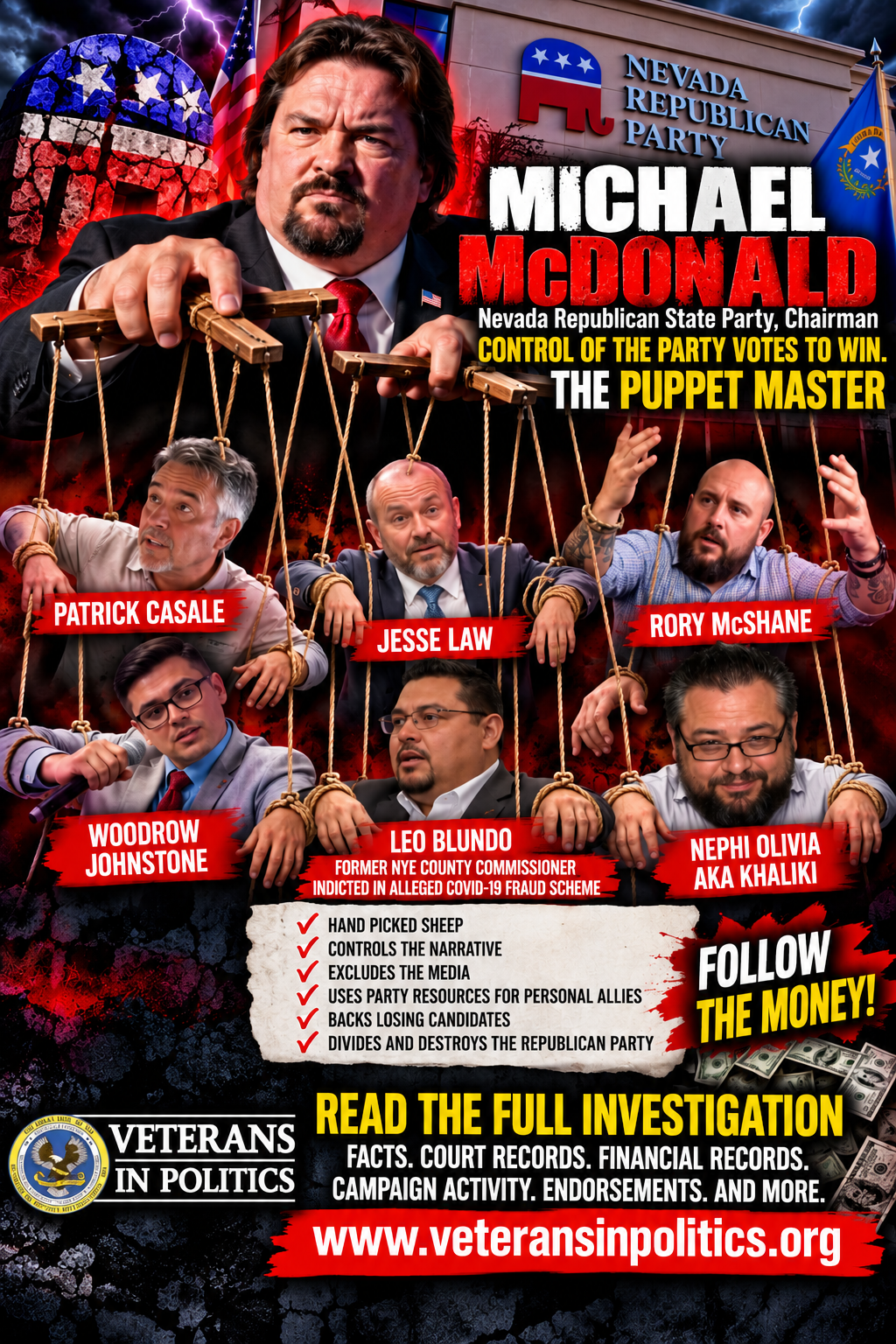
The accompanying Veterans In Politics flyer depicts McDonald as a puppet master surrounded by Patrick Casale, Jesse Law, Rory McShane, Woodrow Johnston, Leo Blundo, and Nephi Oliva, also known as Khaliki.
The imagery is political commentary. The underlying relationships deserve an evidence-based investigation.
And newly published financial reporting provides a particularly compelling place to begin.
1. MICHAEL McDONALD: FOLLOW THE $100,000
On October 27, 2026, The Nevada Independent published an investigation into a political action committee associated with McDonald.
The findings raise significant questions about the relationships among McDonald, Jesse Law, Rory McShane, and organizations receiving political funds.
According to the investigation:
-
Alpha PAC, which lists McDonald as an officer, received a $100,000 contribution from Fighting For Nevada PAC.
-
Fighting For Nevada PAC lists Jesse Law as its registered agent.
-
That PAC uses the same address as a company operated by political consultant Rory McShane.
-
Alpha PAC subsequently reported paying $12,000 to Ops Communications, an organization using the same address as Law’s voter registration.
-
Approximately 40% of Alpha PAC’s historical expenditures were categorized as consulting payments to organizations associated with McDonald or Law, or payments to Law.
-
Approximately 6% of the PAC’s historical spending was categorized as spending for political candidates, organizations, or initiatives.
The newspaper reported that Law, McDonald, and donor Joshua Walters did not respond to requests for comment. McShane declined to comment.
These transactions do not, by themselves, establish illegal conduct.
But they raise an obvious accountability question:
How much of the money raised through Republican-affiliated political organizations reaches candidates and voters, and how much circulates among consultants and politically connected insiders?
This is a question that deserves answers supported by financial records, contracts, and itemized expenditure reports.
2. JESSE LAW: THE DIRECT CONNECTION TO McDONALD
Jesse Law’s connection to McDonald is established through party leadership, political activity, and campaign-finance records.
Law previously served as chairman of the Clark County Republican Party.
Both Law and McDonald participated in the disputed 2020 Nevada Republican elector ceremony and were subsequently criminally charged.
In August 2026, District Judge Mary Kay Holthus dismissed the Nevada criminal case, finding deficiencies in the prosecution’s presentation. The attorney general indicated an intention to appeal. The dismissal must be distinguished from a conviction or finding of guilt.
Law’s more recent involvement with Fighting For Nevada PAC makes the financial relationship especially important.
Questions Law and McDonald should answer: Who authorized the $100,000 transfer? What political work was performed? What services did Ops Communications provide for its reported $12,000 payment? Were any contracts competitively evaluated?
The available evidence establishes political and financial connections. It does not establish that McDonald directs Law’s every political decision.
3. RORY McSHANE: THE CONSULTANT AT THE CENTER OF THE MONEY TRAIL
Rory McShane is a Republican political strategist whose consulting operation has worked on prominent Nevada campaigns.
His connection to this investigation is more than a photograph alongside other Republican operatives.
The October 27 Nevada Independent report identifies the address used by Fighting For Nevada PAC as the same address associated with McShane’s consulting business.
A separate investigation by W4NEWS reported that David Flippo’s federal campaign disclosed more than $1.47 million in payments to McShane’s firm, RMC, during the 2026 election cycle. That is campaign spending, not necessarily personal income to McShane.
This makes McShane a significant figure in Nevada Republican campaign operations.
Is Michael McDonald a silent partner in McShane’s consulting business?
Reports and allegations circulating in Nevada Republican political circles suggest that McDonald may have an undisclosed financial interest or silent partnership in McShane’s political consulting business.
This alleged silent partnership has not been independently verified. No ownership agreement, corporate filing, financial disclosure, or other documentary evidence establishing such an arrangement has been identified in the sources reviewed.
Nevertheless, the allegation raises questions that McDonald and McShane should have an opportunity to answer:
-
Does McDonald hold any direct or indirect ownership interest in RMC or another McShane-associated business?
-
Has McDonald received compensation, commissions, consulting fees, or profit distributions from those businesses?
-
Have party funds or funds from affiliated PACs been paid to businesses in which McDonald has a financial interest?
-
Has McDonald participated in decisions awarding contracts to McShane-associated entities?
-
Have any financial interests been disclosed to the appropriate party officials?
If an undisclosed financial relationship exists, it could present significant conflict-of-interest questions. The existence of such a relationship must be established through evidence before any conclusion can be drawn.
The relevant questions also include whether McShane provided services to Fighting For Nevada PAC, whether those services were compensated, and whether any contracts link his firm to the transfer involving Alpha PAC.
Nevada Republicans deserve transparency about any financial relationships between the state chairman and consultants receiving politically connected funds.
4. PATRICK CASALE: WHAT DID THE NEVADA GOP PAY HIM TO DO?
Patrick Casale is a Las Vegas insurance executive associated with The MultiCare Group.
A September 2026 Veterans In Politics investigation examined Nevada Republican Party expenditure records identifying a $5,000 payment to Patrick Casale individually.
That published investigation also raised questions about an additional $40,000 figure, but did not establish the underlying expenditure records necessary to confirm that additional payment.
The $5,000 reported expenditure presents several questions:
Who approved the payment? What services did Casale provide? Was there a written agreement? Did the payment involve fundraising, consulting, reimbursement, or another purpose?
The public should be able to examine the invoice, contract, and approval documentation.
Does the Nevada Republican Party have bylaw authority to pay fundraisers?
Veterans In Politics questions whether the Nevada Republican Party’s bylaws authorize payments to individuals for fundraising services.
Under the party’s organizational structure, Nevada’s Republican National Committee members have fundraising responsibilities. Veterans In Politics contends that fundraising is among the duties those National Committee members are expected to perform.
The concern is whether the state party is paying outside individuals to perform fundraising responsibilities already assigned to elected party representatives.
However, assigning fundraising responsibilities to National Committee members does not automatically prohibit the state party from hiring additional fundraising assistance. A definitive conclusion requires examination of the current bylaws, applicable financial policies, approved budgets, and any governing committee authorizations.
The Nevada Republican Party should identify the specific bylaw or other authority under which any fundraising-related payment to Casale was approved.
The party should also disclose whether the payment was for fundraising, whether it was authorized by the appropriate committee, and what measurable services were delivered.
There is no basis in the records reviewed to conclude that Casale was paid to follow McDonald’s political instructions. However, documented financial relationships involving party officials and politically active businesspeople deserve transparent accounting.
5. WOODROW JOHNSTON: THE YOUNG REPUBLICANS AND THE ENDORSEMENT CONTROVERSY
Woodrow Johnston serves as chairman of the Nevada Young Republicans, having been elected in October 2025. He is also a political strategist.
Johnston’s political activity became controversial during the 2026 Republican congressional primary involving David Flippo.
Nevada News and Views reported that Johnston was working for Flippo’s campaign while the Nevada Young Republicans endorsed Flippo.
The publication also described a controversy involving a recorded conversation with congressional candidate Cody Whipple and a Nevada Young Republicans official who reportedly participated in the conversation.
Additionally, the Washoe County Young Republicans’ charter became the subject of a dispute after the local chapter endorsed a candidate opposed by the statewide organization’s preferred candidate. Johnston maintained that the chapter had violated organizational bylaws.
The central issue is whether political consultants holding leadership positions in endorsement organizations have adequate safeguards against conflicts of interest.
Did Johnston recuse himself from endorsement decisions involving his clients? Were the organization’s endorsement procedures independently supervised? Were all candidates treated equally?
Those questions deserve documented answers.
But the available evidence does not establish that McDonald ordered Johnston to manipulate endorsements.
6. LEO BLUNDO: FEDERAL FRAUD AND MONEY-LAUNDERING CHARGES
Leo Blundo, a former Nye County commissioner, has the most serious publicly documented criminal allegations among the figures in the flyer.
On March 11, 2026, the U.S. Department of Justice announced that a federal grand jury had indicted Blundo on:
-
Five counts of wire fraud.
-
Two counts of money laundering.
Federal prosecutors alleged that Blundo obtained more than $500,000 in COVID-19 relief funding for his Pahrump restaurant, Carmelo’s Bistro, through applications containing inflated financial and employee information.
The allegations concern federal relief programs, including PPP, EIDL, and the Restaurant Revitalization Fund.
These are criminal charges, not convictions. Blundo is presumed innocent unless proven guilty. A later disposition of those charges has not been verified for this article.
Steve Sanson files a formal complaint seeking Blundo’s removal from the Nevada Republican Party
Steve Sanson, President of Veterans In Politics International, Inc., states that he has submitted a formal complaint to the Nevada Republican Party Executive Committee requesting the removal of Leo Blundo for cause.
Sanson has requested that the matter be addressed through the party’s established procedures at the next State Central Committee meeting.
The complaint raises concerns about Blundo’s continued party leadership in light of the federal indictment, as well as other concerns Sanson has raised about Blundo’s conduct and leadership.
Sanson’s position is that party leadership must be accountable to the organization’s members and must meet the standards expected of individuals representing Nevada Republicans.
The complaint is a request for internal party action. It does not establish that Blundo committed the federal offenses alleged in the indictment.
The Nevada Republican Party should clarify whether the Executive Committee has accepted the complaint, what procedures apply, and whether the matter will be placed before the appropriate governing body.
For Republican Party accountability, the relevant questions are whether Blundo holds a party leadership position, what responsibilities accompany that position, and how the organization addresses serious pending criminal charges involving its officials.
Nothing in the federal indictment establishes that McDonald directed Blundo’s alleged activities or participated in the alleged fraud.
7. NEPHI OLIVA, ALSO KNOWN AS KHALIKI: A CONVICTION AND A COMPLICATED POLITICAL HISTORY
Nephi Oliva, publicly known as Nephi Khaliki, has been involved in Republican politics, concealed-carry firearms instruction, and political controversies in Nevada.
A September 2026 Veterans In Politics investigation reported that Oliva pleaded guilty to conspiracy to commit forgery in March 2025 following an investigation involving concealed-carry instructor credentials.
The report identified Clark County District Court Case No. C-25-389290-1 and described a judgment of conviction filed March 6, 2025.
It also documented a separate federal civil-rights lawsuit Oliva filed against law-enforcement and regulatory defendants.
His political history is particularly important when examining the puppet-master claim.
Oliva previously criticized McDonald and Jesse Law publicly, including advocating changes to Republican leadership.
That history complicates any suggestion that Oliva has consistently operated under McDonald’s direction.
A political alliance, if one currently exists, would need to be demonstrated through actual endorsements, communications, payments, or coordinated activity—not inferred from a photograph.
8. HOW DOES McDONALD EXERCISE INFLUENCE OVER THE NEVADA REPUBLICAN PARTY?
A state party chairman can exercise substantial influence through fundraising, political relationships, public messaging, campaign coordination, committee leadership, and organizational priorities.
McDonald’s longstanding position gives him access to those channels.
But influence is not the same as unilateral control.
The Nevada Republican Party operates under bylaws governing committee membership, voting, officers, and other procedures.
To determine whether McDonald has improperly influenced party decisions, the relevant evidence would include recorded votes, meeting minutes, committee appointments, expenditure approvals, endorsement procedures, and communications showing specific instructions or agreements.
The strongest documented connections among the six figures in the flyer are currently financial and organizational—not proof of a coordinated operation directed by McDonald.
Steve Sanson files a formal complaint seeking Michael McDonald’s removal for cause
Steve Sanson, President of Veterans In Politics International, Inc., states that he has filed a formal complaint with the Nevada Republican Party Executive Committee seeking the removal of Chairman Michael McDonald for cause.
Sanson has requested that the complaint be considered under the party’s bylaws and brought before the appropriate governing body at the next State Central Committee meeting.
The complaint raises concerns involving:
-
McDonald’s management and leadership of the Nevada Republican Party.
-
The transparency of party finances and expenditures.
-
Alleged failures to conduct required Executive Committee meetings.
-
Questions surrounding payments to political consultants and fundraising-related individuals.
-
Allegations of favoritism toward particular candidates and political organizations.
-
Concerns about the treatment of party members, political candidates, and the news media.
-
The party’s electoral performance during McDonald’s chairmanship.
-
Questions about whether party rules and governance procedures have been consistently followed.
These are allegations and governance concerns advanced in Sanson’s complaint, not adjudicated findings of misconduct.
Sanson argues that the Nevada Republican Party must not operate as the personal political organization of any chairman, consultant, or group of insiders.
He has also raised concerns about McDonald’s public characterization of Sanson and Stephanie Phillips as a “cancer” to the party during the October 3, 2026, Republican State Central Committee meeting.
Sanson maintains that McDonald should recuse himself from decisions concerning complaints involving Sanson or Phillips because of the appearance of personal bias.
Whether recusal is required depends on the applicable bylaws and procedures.
The party should publicly clarify the process for considering the removal complaint, including the roles of the Executive Committee and State Central Committee, applicable voting requirements, and safeguards for procedural fairness.
The central question is whether the Nevada Republican Party’s leadership is accountable to its membership—or whether the same leadership structure can prevent members from obtaining meaningful review of their complaints.
9. FOLLOW THE MONEY: THE DOCUMENTS THAT COULD ANSWER EVERYTHING
The party and associated political organizations could address many of these questions by making the following records available:
-
Alpha PAC’s complete financial reports, including contracts and invoices supporting consulting expenditures.
-
Fighting For Nevada PAC’s governing documents and records concerning its $100,000 transfer.
-
The contract and deliverables supporting Alpha PAC’s $12,000 Ops Communications expenditure.
-
Nevada Republican Party invoices, contracts, and authorization records concerning Patrick Casale.
-
Records identifying any payments from the party to McShane-associated consulting businesses.
-
Nevada Young Republicans’ endorsement procedures, conflict-of-interest policies, and relevant recorded votes.
-
Party meeting minutes, treasurer reports, and applicable finance committee records.
-
Any disclosures or business records identifying direct or indirect financial interests McDonald may hold in consulting businesses receiving political funds.
-
The bylaw provisions, financial policies, and authorizations governing payments for fundraising services.
-
Records confirming the receipt, procedural status, and disposition of the formal removal complaints involving McDonald and Blundo.
These documents would help determine who exercised decision-making authority, whether services were performed, and whether party resources were used according to applicable rules.
10. THE BIG QUESTION: WHO BENEFITS FROM THE PARTY’S POLITICAL POWER?
The financial reporting involving Alpha PAC is particularly significant because it identifies actual transactions connecting political organizations and individuals associated with McDonald, Law, and McShane.
The reported $100,000 PAC transfer, $12,000 consulting payment, and substantial historical consulting expenditures deserve examination.
The allegation of an undisclosed business relationship between McDonald and McShane, although unverified, creates an additional question that could be resolved through financial and corporate documentation.
Meanwhile, the controversies surrounding Johnston, Blundo, Oliva, and Casale raise separate questions involving organizational governance, professional relationships, criminal proceedings, and transparency.
Those controversies should not be combined into an allegation of a single conspiracy without evidence connecting them.
Nevada Republicans deserve to know who makes decisions, who receives political money, what services are purchased, and whether the organization’s rules are being followed.
The best way to answer those questions is through records, not speculation.
CONCLUSION: THE CHAIRMAN, THE MONEY, AND THE FUTURE OF THE NEVADA GOP
Michael McDonald has remained chairman since 2012.
That longevity creates a legitimate responsibility to account for the party’s performance, financial management, internal governance, and relationships with political consultants.
The newly reported PAC transactions make financial transparency especially urgent.
The formal removal complaints that Steve Sanson states he has submitted against McDonald and Blundo also place questions of party accountability before Republican leadership.
Will the party provide transparent consideration of those complaints? Will it disclose the records necessary to answer questions about political consulting payments and fundraising expenditures? Will members have a meaningful opportunity to hold leadership accountable?
The question is not whether McDonald knows influential political figures. That is expected of a state party chairman.
The question is whether the financial and organizational relationships surrounding Nevada Republican politics operate transparently, comply with applicable rules, and serve Republican voters rather than a narrow circle of political insiders.
That question deserves a documented answer.
Veterans In Politics International, Inc.
https://veteransinpolitics.org/
PRINCIPAL SOURCES
-
The Nevada Independent — Unraveling a Money Mystery With the Nevada GOP Chair’s PAC
-
W4NEWS — The $145,500 Nevada PAC Trail
-
U.S. Department of Justice — Leo Blundo Indictment
-
Las Vegas Review-Journal — Nevada Electors Case Dismissed
-
Nevada Young Republicans — Executive Leadership
-
Nevada News and Views — Team Flippo and the Young Republicans Controversy
-
Veterans In Politics — The Nephi Khaliki Files
-
Veterans In Politics — Where Are the Nevada GOP Treasurer’s Reports?
-