
Follow the Money: Where Are the Nevada GOP Treasurer’s Reports?
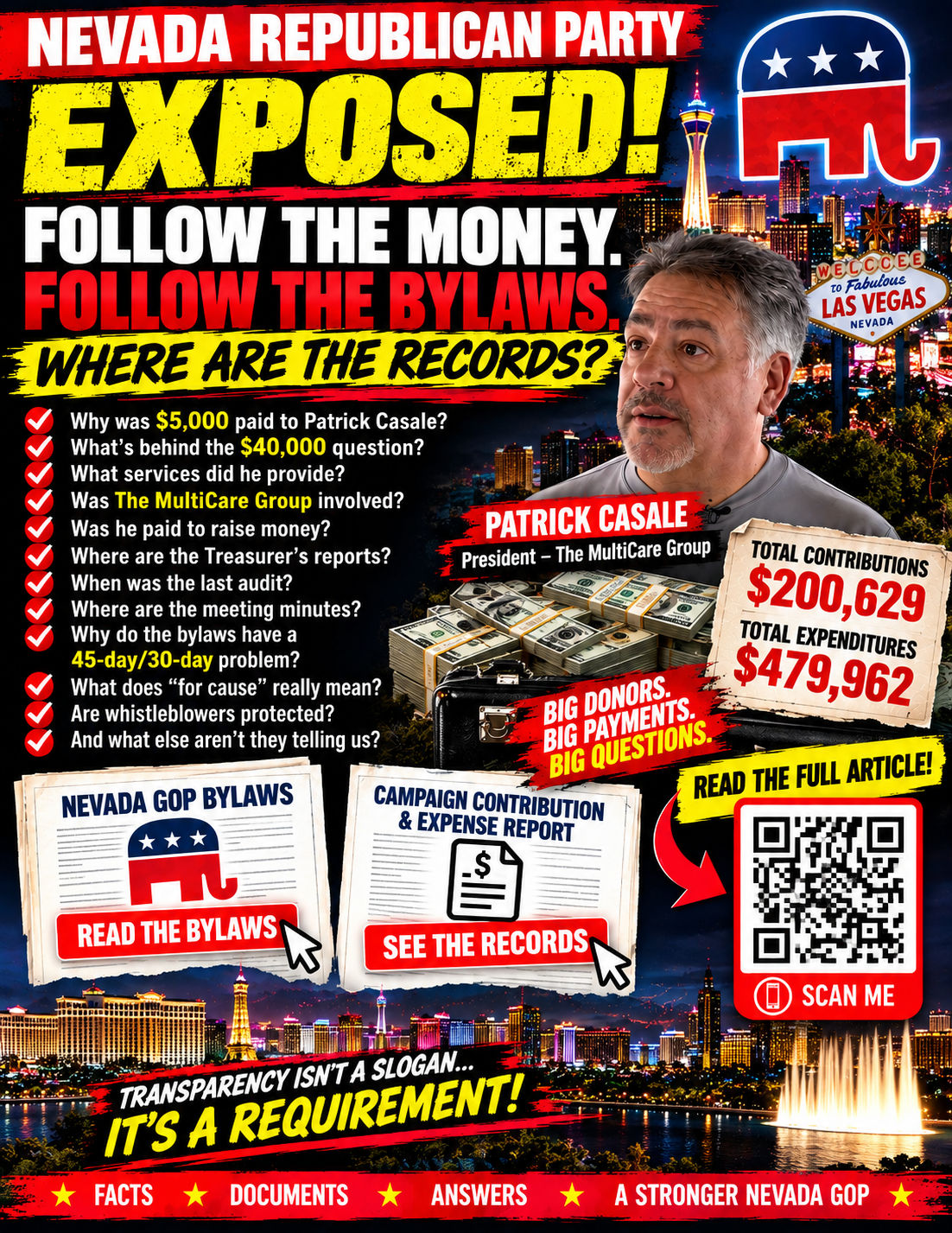
The Nevada GOP Questions About Money, Patrick Casale, MultiCare, Financial Reports, Audits, Fundraising, Whistleblowers—and the Party’s Own Rules
The Nevada Republican Party has bylaws.
Those bylaws establish who controls the money, who oversees fundraising, who keeps the minutes, when financial reports must be presented, when financial records must be made available to NRCC members, and how the organization’s own rules can be amended.
So the issue is not whether rules exist.
The issue is whether Nevada Republicans can see the records necessary to determine whether those rules are actually being followed.
The current bylaws posted by the Nevada Republican Party are identified by the party as the “BYLAWS OF THE NEVADA REPUBLICAN PARTY.”
OFFICIAL NEVADA REPUBLICAN PARTY BYLAWS — READ THE DOCUMENT YOURSELF
CLICK HERE TO VIEW THE OFFICIAL NEVADA REPUBLICAN PARTY BYLAWS (PDF):
https://nevadagop.org/wp-content/uploads/2022/02/BYLAWS-OF-THE-NEVADA-REPUBLICAN-PARTY.pdf
The importance of providing the actual document cannot be overstated. Nevada Republicans should not have to rely on anyone else’s interpretation—including mine. Read the bylaws. Compare the language. Examine the financial provisions. Examine the meeting-notice provisions. Examine the amendment provisions. Then decide for yourself what they require.
A review of those bylaws, campaign-finance disclosures, publicly available meeting information and business records concerning Patrick Casale and The MultiCare Group raises serious questions that deserve specific, documented answers.
Among them:
Why does Nevada campaign-finance data show $5,000 paid directly to Patrick Casale?
What is the basis for an additional $40,000 figure that has been raised concerning Casale, and where are the underlying expenditure records supporting it?
What services did Casale provide?
What role, if any, did The MultiCare Group play?
Was Casale involved in fundraising?
If he was, how was he compensated?
Where are the Treasurer’s reports that the bylaws require at regular meetings?
When was the party’s last financial audit?
Why aren’t recent NRCC minutes and financial reports readily available in the public material reviewed for this investigation?
Why do the bylaws themselves contain a 45-day requirement in one provision and 30-day language in another affecting the process for amending those same bylaws?
And there is another fundamental problem:
If members are required to submit an amendment in connection with a meeting call issued 45 days before the meeting, how are ordinary NRCC members supposed to comply if they don’t know the meeting date before that 45-day call is issued?
These questions should not be answered by rumor.
They should be answered with documents.
$5,000 TO PATRICK CASALE
The Nevada Republican Party Central Committee’s campaign-finance data identifies Patrick Casale as an individual payee receiving $5,000.
The reporting data is explicit:
Patrick Casale — Individual — $5,000.
That is not an allegation.
That is what the campaign expenditure data reports.
But the entry raises questions the summary does not answer.
What was Casale paid to do?
Was this consulting?
Fundraising?
Reimbursement?
Professional services?
A flat fee?
Was there a contract?
Was there an invoice?
Who authorized the payment?
The expenditure report establishes that money was reported as going to Casale.
It does not, standing alone, explain the underlying business arrangement.
THE CAMPAIGN CONTRIBUTION & EXPENSE REPORT — LOOK AT THE RECORDS YOURSELF
The campaign-finance report/data should be examined alongside the party bylaws.
NEVADA REPUBLICAN PARTY CENTRAL COMMITTEE — CAMPAIGN CONTRIBUTIONS & EXPENSES
CLICK HERE TO VIEW THE NEVADA GOP CAMPAIGN CONTRIBUTION & EXPENSE DATA:
https://www.transparencyusa.org/nv/committee/nevada-republican-party-central-committee-pac-1444
Readers should examine the expenditures themselves rather than relying solely on commentary about them.
The campaign-finance data reviewed for the Nevada Republican Party Central Committee reports:
TOTAL CONTRIBUTIONS: $200,629
TOTAL EXPENDITURES: $479,962
Among the listed top expenditures/payees:
Nevada Republican Party Central Committee — $419,928.29
Nevada Republican Central Committee – Federal — $38,744.11
Majority Strategies LLC — $15,089.70
Patrick Casale — Individual — $5,000
Washoe County Republican Central Committee — $1,200
The same report identifies several major contributors, including:
Richard MacDonald — $100,000
Arizona Land Reserve LLC — $50,000
Daniel Schwartz — $20,000
John Kelsey — $17,500
Nevada Way PAC — $5,000
Those figures matter because they provide context. This is an organization moving substantial amounts of political money.
The campaign expense report is not a substitute for the party’s internal accounting records, invoices, contracts, Treasurer’s reports or authorization records.
It is the starting point for asking where the money went, why it was spent, and what documentation supports the expenditures.
AND THEN THERE IS THE $40,000 QUESTION
An additional $40,000 figure concerning payments to Casale has been raised during this investigation.
That number deserves attention—but also precision.
I have not yet located the underlying primary Nevada C&E expenditure entries sufficient to independently establish that an additional $40,000 was paid by the Nevada Republican Party to Patrick Casale.
Therefore, the responsible question is not to declare the $40,000 proven.
The question is:
WHERE ARE THE RECORDS SUPPORTING THE $40,000?
If the $40,000 figure is accurate, produce the expenditures.
Show the dates.
Show the checks.
Show the invoices.
Show the purpose.
Show who authorized them.
And show what the Nevada Republican Party received for the money.
If the $40,000 figure is wrong, the records can establish that too.
Financial accountability works both ways.
WHO IS PATRICK CASALE?
Patrick Casale isn’t merely a name appearing on a campaign-finance report.
He is a longtime Las Vegas insurance executive.
Casale has been publicly identified as president of The MultiCare Group and previously as managing partner of its Las Vegas operations.
Therefore, Casale’s affiliation with MultiCare isn’t speculation.
It is independently documented.
THE MULTICARE GROUP CONNECTION
That makes The MultiCare Group relevant to examining Casale’s professional background and any services he may have provided.
But here is where facts matter.
The $5,000 campaign-finance entry reviewed does not say:
The MultiCare Group — $5,000.
It says:
Patrick Casale — Individual — $5,000.
That distinction cannot simply be erased.
At the same time, Casale’s documented leadership role at MultiCare makes several questions reasonable:
Was Casale acting individually?
Was he providing services connected to his business?
Did MultiCare submit an invoice?
Was there an agreement between MultiCare and the Nevada GOP?
Did Nevada GOP money separately go to MultiCare?
Or did MultiCare have absolutely nothing to do with the $5,000 expenditure?
Produce the financial records and answer the questions.
WAS CASALE PAID TO RAISE MONEY?
Another question concerns whether Casale was compensated for fundraising—and specifically whether anyone was receiving a percentage of money raised.
The evidence reviewed so far does not establish that the $5,000 payment was a percentage-based fundraising commission.
Nor have I verified that the reported $40,000 figure represented fundraising compensation.
But if Casale was raising money for the Nevada GOP, the party’s own bylaws become extremely important.
THE BYLAWS SAY WHO OVERSEES FUNDRAISING
The Nevada Republican Party bylaws establish a Finance Committee.
Its membership includes the party’s National Committeeman and National Committeewoman, along with other designated members.
The critical language says the Finance Committee:
“shall oversee all fundraising programs of the NVGOP.”
Those words matter.
ALL FUNDRAISING PROGRAMS.
Therefore, if Patrick Casale was engaged to raise money for the Nevada Republican Party:
WHAT ROLE DID THE FINANCE COMMITTEE PLAY?
Was the committee informed?
Was a fundraising plan presented?
Did it approve or oversee the program?
Was Casale’s compensation disclosed?
Did the committee review the results?
Were minutes kept?
Was a written contract executed?
These are questions created by the governance structure in the Nevada GOP’s own bylaws.
ISN’T FUNDRAISING THE NATIONAL COMMITTEEMAN’S JOB?
The bylaws require a more precise answer.
They do not simply designate the National Committeeman as the Nevada GOP’s sole fundraiser.
Instead, both the National Committeeman and National Committeewoman sit on the Finance Committee.
And that Finance Committee is expressly charged with overseeing all Nevada GOP fundraising programs.
Therefore, the question isn’t whether the National Committeeman personally had to solicit every contribution.
The question is whether fundraising programs were overseen through the structure established by the bylaws.
WHAT THE NEVADA GOP BYLAWS ACTUALLY REQUIRE
Again, readers can inspect the governing document directly:
OFFICIAL NEVADA REPUBLICAN PARTY BYLAWS:
https://nevadagop.org/wp-content/uploads/2022/02/BYLAWS-OF-THE-NEVADA-REPUBLICAN-PARTY.pdf
The party’s own bylaws should be read alongside these financial questions.
Under Article 4, the Treasurer is the chief financial officer of the Nevada GOP and NRCC.
The Treasurer is the custodian of the organization’s financial assets.
The bylaws require the Treasurer to pay expenses in compliance with the NVGOP budget, subject to the exceptions provided by the bylaws.
The Treasurer must:
Keep a strict accounting of all revenues and expenses using generally accepted accounting practices.
The Treasurer must make those records accessible to:
The Chairman;
The Executive Committee; and
All members of the NRCC upon request.
The Treasurer must also file legally required federal and state reports and disclosures in a timely manner.
These provisions aren’t campaign promises.
They are the party’s own governing rules.
WHERE ARE THE TREASURER’S REPORTS?
The Treasurer is not a ceremonial officer.
The bylaws require current financial reports to be provided at regular NRCC and Executive Committee meetings.
That creates a remarkably simple question:
WHEN WAS THE LAST TREASURER’S REPORT GIVEN TO THE NRCC?
Our examination of publicly accessible Nevada GOP material did not establish the date of the most recent Treasurer’s report presented to the full NRCC.
That does not prove reports weren’t given.
But if they were given, the documentation should settle the matter.
Produce the reports.
WHERE ARE THE MINUTES?
The Nevada GOP held a full NRCC Summer Meeting on July 12, 2025, in Winnemucca.
Yet the publicly accessible material reviewed for this investigation did not provide minutes establishing whether the required Treasurer’s report was presented there.
A similar problem arose in reviewing publicly accessible material concerning the May 3–4, 2024 State Convention.
Again, absence from a public website does not prove that a Treasurer’s report wasn’t delivered.
But that leads directly to another bylaw requirement.
THE SECRETARY IS SUPPOSED TO KEEP THE MINUTES
The Nevada Republican Party Secretary has specific recordkeeping responsibilities.
The Secretary must keep minutes of NVGOP Convention, NRCC and Executive Committee meetings.
The bylaws also establish requirements for making those minutes available to the appropriate members.
Therefore:
The minutes should exist.
If the Treasurer delivered the required financial reports, the minutes should help establish when.
The Secretary identified in the material reviewed for 2026 is Barbara “Barb” Hawn.
The Treasurer identified in the material reviewed is Kathy Njus.
So produce the minutes.
Then Nevada Republicans don’t have to speculate.
NRCC MEMBERS HAVE A RIGHT UNDER THE BYLAWS TO REQUEST ACCOUNTING RECORDS
This may be one of the most important provisions in the entire document.
The bylaws require the Treasurer to make accounting records accessible to all members of the NRCC upon request.
Read that again:
ALL MEMBERS OF THE NRCC UPON REQUEST.
If an NRCC member wants to investigate the Casale expenditure, there is a bylaw-based mechanism for requesting the party’s accounting records.
If the additional $40,000 exists, those records should reveal it.
If MultiCare received money, the accounting trail should reveal it.
If fundraising compensation existed, invoices and contracts should help establish the arrangement.
If none of those things occurred, the records can establish that as well.
WHEN WAS THE LAST AUDIT?
Another straightforward question:
WHEN WAS THE NEVADA GOP LAST AUDITED?
The bylaws provide for an audit of the financial records when requested by the Executive Committee.
But the publicly available material reviewed for this investigation did not establish the date of the party’s most recent audit.
Again, that does not prove an audit hasn’t occurred.
It means we could not verify one from the material examined.
So:
When was it?
Who performed it?
What years did it cover?
Was a written report prepared?
Was it presented to the Executive Committee?
Were deficiencies identified?
Were recommendations made?
Can NRCC members review it?
Produce the audit and eliminate the questions.
THE PARTY’S OWN BYLAWS CREATE A 45-DAY/30-DAY PROBLEM
This is not somebody paraphrasing the rules.
Readers can examine the actual bylaws themselves:
CLICK HERE — OFFICIAL NEVADA GOP BYLAWS:
https://nevadagop.org/wp-content/uploads/2022/02/BYLAWS-OF-THE-NEVADA-REPUBLICAN-PARTY.pdf
Article 8 provides that meeting calls must be sent no less than 45 days before a scheduled meeting.
Article 13, concerning amendments, says proposed amendments must be included in the meeting call and mailed at least 30 days before the meeting.
That creates an obvious conflict in practical application.
Is it 45 days?
Or 30 days?
But there is an even bigger problem.
HOW IS AN NRCC MEMBER SUPPOSED TO KNOW THE DEADLINE IF THE MEMBER DOESN’T KNOW WHEN THE MEETING WILL BE?
Think about the mechanics.
If leadership determines the date of the next NRCC meeting and the formal meeting call announcing that meeting does not have to be sent until 45 days before the meeting, an ordinary NRCC member may not know the meeting date until the call arrives.
But if an amendment must already be included in that call, how does that member submit an amendment in time?
By the time the member receives the 45-day call announcing the meeting, the opportunity to have an amendment included in that very same call may already have passed.
That creates a potential procedural Catch-22.
Members are expected to comply with a deadline tied to a meeting date.
But if leadership has not announced the meeting date sufficiently beforehand, how can members calculate that deadline?
The current situation illustrates why that question matters. The Nevada GOP’s public calendar now identifies the 2026 NRCC Fall Meeting for October 3, 2026.
But the larger bylaw question remains independent of this particular meeting:
What provision guarantees that NRCC members will receive the next meeting date early enough to exercise their amendment rights?
The bylaws should clearly establish:
When future NRCC meeting dates must be announced;
When amendments must be submitted;
Who receives proposed amendments;
Whether the controlling deadline is 30 days or 45 days;
And what happens when a meeting date is announced too late for an ordinary member to comply with the amendment procedure.
A rule should not require members to know a date they have not yet been given.
“FOR CAUSE” — BUT WHAT IS CAUSE?
The bylaws repeatedly permit officers and NRCC members to be removed “for cause.”
But the provisions reviewed do not provide a detailed definition of what constitutes cause.
What is cause?
Violating the bylaws?
Financial misconduct?
Missing meetings?
Publicly criticizing leadership?
Failure to perform official duties?
Criminal conduct?
Conduct allegedly detrimental to the organization?
Something else entirely?
When a standard can be used to remove an elected party representative, its meaning should be sufficiently clear to permit consistent application.
Otherwise, “cause” risks becoming whatever the people exercising the removal power decide it means in a particular dispute.
WHISTLEBLOWERS: WHAT PROTECTION ACTUALLY EXISTS?
Members who discover what they believe are financial irregularities or violations may understandably ask:
“Am I protected as a whistleblower if I report this?”
The answer requires caution.
Nevada has statutory whistleblower provisions in NRS 281.611 through NRS 281.671, but those provisions principally concern state officers and employees and local governmental officers and employees who disclose improper governmental action.
A Nevada Republican Party officer or NRCC member is not automatically covered by those public-employee whistleblower statutes merely because he or she reports alleged misconduct within a political party.
That distinction is critical.
For individuals who actually fall within the statute, Nevada law addresses reprisals involving specified adverse governmental employment actions following qualifying disclosures.
Depending upon the particular circumstances, other legal protections can also become relevant.
Nevada’s anti-SLAPP statutes, for example, address certain good-faith communications connected with petitioning government or free speech concerning issues of public concern.
But anti-SLAPP protection is not automatic merely because somebody calls himself or herself a whistleblower.
The communication and circumstances must satisfy the statute.
DO NOT ASSUME “WHISTLEBLOWER” AUTOMATICALLY MEANS “LEGALLY IMMUNE FROM RETALIATION.”
Legal protection depends upon the person’s status, what was disclosed, to whom it was disclosed, the type of alleged retaliation, and the particular statute involved.
THE BIGGER ISSUE ISN’T ONE CHECK
This investigation should not be reduced to one $5,000 payment.
The bigger issue is whether Nevada Republican Party financial and organizational procedures are transparent enough for the people charged with governing the organization to determine whether their own bylaws are being followed.
The party has rules requiring financial accounting.
It has rules requiring financial reports.
It has rules giving NRCC members access to accounting records upon request.
It has rules governing fundraising oversight.
It has rules governing minutes.
It has provisions concerning audits.
It has rules governing amendments.
It has provisions permitting removal “for cause.”
The rules exist.
The question is what the records show about compliance.
THE DOCUMENTS THAT SHOULD SETTLE THIS
The Nevada Republican Party can resolve most of these questions through records.
Produce:
The invoice supporting the $5,000 Patrick Casale expenditure.
Any contract between Patrick Casale and the Nevada Republican Party.
Any contract, invoice or payment involving The MultiCare Group.
Documentation supporting or disproving the additional $40,000 figure.
Finance Committee minutes involving Casale or any fundraising program in which he participated.
The authorization for the $5,000 expenditure and any other Casale expenditures.
NRCC meeting minutes from 2023 through 2026.
The Treasurer’s reports presented at every regular NRCC meeting.
The date and report of the most recent financial audit.
Any Executive Committee action requesting an audit.
The accounting records that Article 4 says NRCC members may access upon request.
Then everyone can read the documents and reach their own conclusions.
WHAT IS FACT — AND WHAT REMAINS A QUESTION
FACT: The campaign-finance data reviewed identifies $5,000 paid to Patrick Casale individually.
FACT: The same dataset reports $200,629 in contributions and $479,962 in expenditures for the committee reporting displayed.
FACT: Patrick Casale is publicly documented as affiliated with and serving in leadership of The MultiCare Group.
NOT YET ESTABLISHED: That the Nevada Republican Party’s $5,000 payment went to MultiCare.
NOT YET ESTABLISHED: That an additional $40,000 was paid to Casale. The figure has been raised, but the underlying primary expenditure documentation still needs to be produced before it should be stated as established fact.
NOT YET ESTABLISHED: That Casale received a percentage of fundraising proceeds.
FACT: The Nevada GOP bylaws charge the Finance Committee with overseeing all fundraising programs.
FACT: The National Committeeman and National Committeewoman are members of that committee.
FACT: The Treasurer must maintain accounting records and make them accessible to NRCC members upon request.
FACT: The bylaws require current financial reports at regular NRCC and Executive Committee meetings.
FACT: The bylaws provide for an audit when requested by the Executive Committee.
NOT YET ESTABLISHED: The date of the most recent audit from the public records reviewed.
NOT YET ESTABLISHED: The date of the most recent Treasurer’s report from the publicly available material reviewed.
FACT: The bylaws contain a 45-day meeting-call requirement and separate 30-day amendment language.
PRACTICAL QUESTION: If the meeting date isn’t disclosed until the 45-day call, how can an NRCC member get a proposed amendment into that same call?
FACT: The bylaws use the phrase “for cause” in removal provisions without providing a detailed definition in the provisions reviewed.
LEGAL FACT: Nevada’s principal public-sector whistleblower statute protects covered government officers and employees; it does not automatically turn every Nevada GOP member reporting internal party concerns into a protected public-sector whistleblower.
READ THE DOCUMENTS YOURSELF
This investigation should not require readers to take anybody’s word for what the governing documents or campaign-finance records say.
NEVADA REPUBLICAN PARTY BYLAWS
CLICK TO READ:
https://nevadagop.org/wp-content/uploads/2022/02/BYLAWS-OF-THE-NEVADA-REPUBLICAN-PARTY.pdf
NEVADA REPUBLICAN PARTY CENTRAL COMMITTEE — CAMPAIGN CONTRIBUTIONS & EXPENDITURES
CLICK TO REVIEW:
https://www.transparencyusa.org/nv/committee/nevada-republican-party-central-committee-pac-1444
Read them.
Compare them.
Ask questions.
Request the underlying records available to NRCC members under the bylaws.
THE NEVADA GOP DOESN’T NEED MORE RUMORS. IT NEEDS RECORDS.
The strongest criticism isn’t an unsupported accusation.
It is a documented question that should have a documented answer.
What was Patrick Casale paid to do?
Where did the $5,000 go?
What is behind the additional $40,000 figure?
Was The MultiCare Group involved?
Was Casale involved in fundraising?
If so, how was he compensated?
Did the Finance Committee oversee it?
When was the last Treasurer’s report?
When was the last audit?
Where are the meeting minutes?
Where are the financial records that the bylaws say NRCC members can request?
Why do the bylaws say 45 days in one place and 30 days in another?
How can an NRCC member meet an amendment deadline tied to a meeting date that may not yet have been announced?
And what exactly constitutes “cause” when the party seeks to remove one of its own members or officers?
The Nevada Republican Party doesn’t have to answer those questions with speeches, factions, personalities or rhetoric.
IT CAN ANSWER THEM WITH RECORDS.
Produce the contracts.
Produce the invoices.
Produce the campaign expense reports.
Produce the minutes.
Produce the Treasurer’s reports.
Produce the audit.
Produce the authorizations.
Produce the accounting records the bylaws say NRCC members can request.
Follow the money.
Follow the minutes.
Follow the bylaws.
And let the documents tell Nevada Republicans what actually happened.