SAME FAILED LEADERSHIP OR A NEW DIRECTION?
A Close Examination of Steven Horsford’s Money, Controversies, Voting Record and Years in Power
Nevada’s Fourth Congressional District has a serious question to consider in 2026:
After years of Steven Horsford representing this district in Washington—and years before that as one of Nevada’s most powerful state legislators—what does his complete record actually show?
This question shouldn’t be answered by campaign commercials, political parties, rumors or social-media posts.
Follow the record. Follow the money. Follow the votes. Follow the controversies. And ask what has actually changed for the people of Nevada’s Fourth Congressional District.
The district stretches from North Las Vegas into vast portions of rural Nevada.
Residents confront long drives, dangerous highway corridors, cellular dead zones, limited rural medical access, veterans living far from major VA facilities, water concerns and the consequences of the federal government’s enormous landholdings in Nevada.
Horsford has had years in elected office to address federal issues affecting those communities.
That makes accountability—not rhetoric—the central issue.
HOW LONG SHOULD AN INCUMBENT GET TO PRODUCE RESULTS?
Horsford has been part of Nevada politics for decades.
He served in the Nevada Senate, rose to Senate majority leader, won Nevada’s newly created Fourth Congressional District in 2012, lost the seat in 2014 and returned to Congress following the 2018 election.
That is a substantial amount of time in government.
And with longevity comes responsibility for a record.
So residents should ask:
Are rural roads safer?
Is cellular coverage adequate?
Do rural veterans have sufficient access to services?
Do rural communities have sufficient medical infrastructure?
Is Nevada adequately prepared for its long-term water challenges?
Has Washington effectively addressed federal-land issues affecting housing and economic development?
No member of Congress controls all these issues alone. State and local governments, federal agencies and private companies also have responsibilities.
But Congress controls enormous amounts of federal spending and influences transportation, veterans’ programs, telecommunications, public lands, health care and water policy.
After years in office, the relevant question isn’t whether Horsford personally caused these problems.
It is:
WHAT DID HE DO TO SOLVE THEM?
And where are the measurable results?
THE NEVADA PARTNERS CONTROVERSY
Questions involving Horsford, government money and potential conflicts of interest go back more than two decades.
In 2004, the Las Vegas Sun reported concerns involving Nevada Partners, the nonprofit where Horsford served as president.
The Southern Nevada Workforce Investment Board distributed federal employment money to organizations including Nevada Partners.
At the same time, Horsford served on that board while serving as president of Nevada Partners.
The Las Vegas Sun editorial board called the arrangement a “clear conflict.”
Questions also arose concerning documentation for approximately $500,000 in spending. The documentation was subsequently located and accepted.
The Sun further reported that the Workforce Investment Board had cited Nevada Partners over two contracts that resulted in more than $100,000 being paid without the board’s knowledge. Horsford resigned from the Workforce Investment Board in June 2004.
The evidence does not establish that Horsford stole the money or committed a crime.
But the conflict-of-interest controversy remains part of his documented public record.
Read the 2004 Las Vegas Sun editorial on Nevada Partners and Horsford
MONEY, ACCESS AND VICTORY 2010
Years later, another controversy developed around political fundraising and access.
Horsford’s Victory 2010 PAC promoted a fundraising arrangement involving opportunities for contributors to participate in meals or receptions with Democratic legislative leaders and committee chairs.
The arrangement drew criticism because of the appearance that campaign contributions could provide unusual access to powerful lawmakers.
Horsford abandoned the program.
Subsequent reporting indicated that 15 contributions were returned.
This does not establish criminal wrongdoing.
But it raises an enduring political question:
Where is the line between raising political money and providing donors access to political power?
THEN CAME POKERSTARS
The PokerStars episode deserves particular attention.
In 2011, PokerStars was pursuing legislation affecting Internet poker in Nevada.
Contemporary Las Vegas Sun reporting described an extensive political operation involving lobbyists, contributions and Nevada lawmakers.
During this period, the Sun reported that then-Senate Majority Leader Steven Horsford was treated to a trip to the Bahamas, where PokerStars principals were attending a conference.
PokerStars had a substantial interest in Nevada’s Internet-gambling policies.
The chronology warrants scrutiny.
It does not establish that Horsford accepted a bribe or participated in an illegal quid pro quo.
But voters can reasonably ask:
Why was a company seeking favorable public policy providing travel involving one of Nevada’s most powerful legislators?
What legislation was pending?
What political contributions were being made?
What actions occurred before and after the trip?
Those questions should be answered from records.
Read the Las Vegas Sun investigation into PokerStars’ Nevada political operation
PRIVATE BUSINESS AFTER LOSING CONGRESS
After losing his congressional seat in 2014, Horsford entered private business.
He established Resources+ and became associated with R&R Partners, which was publicly described as a minority investor.
Operating a business isn’t misconduct.
The public-interest questions concern transparency:
Who were the clients?
What financial relationships existed?
Were all required interests properly disclosed?
Did former clients or business relationships subsequently have interests before Congress after Horsford returned to Washington?
These are questions that should be examined through financial disclosures and other public records.
THE AFFAIR—AND THEN THE MONEY QUESTIONS
In 2020, Horsford publicly acknowledged an extramarital relationship with Gabriela Linder.
That disclosure became a significant personal and political controversy.
Then came questions involving money.
The Nevada Current reported that Horsford acknowledged transferring money in 2019 from Resources+ Partners to Linder.
His chief of staff said those transfers represented personal gifts funded from Horsford’s personal income.
An ethics complaint was subsequently filed.
Accuracy matters:
An affair isn’t bribery.
A financial transfer isn’t automatically campaign-finance misconduct.
An ethics complaint isn’t a finding of guilt.
But the acknowledged affair, its duration, the financial transfers and resulting controversy are documented elements of Horsford’s public record.
THE DIVORCE—AND THE ALLEGED NDA
The controversy didn’t completely disappear after Horsford publicly acknowledged the affair.
His wife, Dr. Sonya Douglass, filed for divorce in 2022.
During that period, Douglass publicly accused Horsford of attempting to require her to sign a nondisclosure agreement.
According to her publicly reported allegations, the proposed NDA would have restricted what she could publicly say concerning their marriage, Horsford’s affair and their divorce.
Douglass further alleged that the proposed agreement contained $10,000 penalties for individual public remarks, social-media posts or other disclosures covered by the agreement.
The distinction here is important:
Douglass publicly alleged that Horsford sought the NDA. Reliable evidence establishing that she actually signed such an agreement has not been identified.
That distinction should not be blurred.
But her allegation concerning the proposed NDA became part of the public controversy surrounding the dissolution of their marriage.
MOMS FOR LIBERTY AND CONSERVATIVE ORGANIZATIONS: HORSFORD’S VOTING RECORD UNDER SCRUTINY
Information provided to Veterans In Politics concerning Moms for Liberty identifies Representative Steven Horsford (D-NV), representing Nevada’s Fourth Congressional District, as receiving low or failing assessments from conservative organizations because of his congressional voting record and its alignment with Democratic policy positions.
Moms for Liberty describes its broader mission as empowering parents to defend parental rights, holding government leaders accountable and opposing what the organization considers government overreach.
Its Clark County, Nevada chapter publicly promotes those principles.
The Clark County chapter states that Moms for Liberty works to hold decision-makers accountable, spread awareness concerning what it views as the limited role of government, oppose government overreach, promote liberty, engage elected leaders on issues affecting families and encourage people sharing those principles to seek elected office.
Moms for Liberty — Clark County, Nevada chapter
The specific information concerning Horsford’s low or failing assessments is being attributed here to information provided to Veterans In Politics. A publicly available national Moms for Liberty congressional scorecard assigning Horsford a specific grade was not independently located.
The broader question of Horsford’s ideological voting record can also be examined through published scorecards maintained by conservative advocacy organizations.
Those scorecards measure agreement with policy positions selected by the organizations themselves. They should therefore be understood as ideological measurements—not neutral evaluations of a congressman’s overall performance.
For voters concerned about parental rights, education policy, government spending, taxation, regulation, limited government and related conservative issues, these records provide another avenue for examining Horsford’s congressional voting history.
The question is straightforward:
WHAT DOES STEVEN HORSFORD ACTUALLY VOTE FOR WHEN HE GETS TO WASHINGTON?
Voters don’t have to rely upon campaign advertisements to answer that.
They can examine his individual votes and compare them with their own priorities.
FOLLOW THE MONEY
Now examine Horsford’s current political operation.
These numbers aren’t allegations.
They come directly from the Federal Election Commission.
For the 2025–2026 cycle through June 30, 2026, Nevadans for Steven Horsford reported:
TOTAL RECEIPTS: $3,350,562.82
TOTAL CONTRIBUTIONS: $3,125,110.26
INDIVIDUAL CONTRIBUTIONS: $1,336,757.39
OTHER POLITICAL COMMITTEE CONTRIBUTIONS: $1,782,759.15
TRANSFERS FROM OTHER AUTHORIZED COMMITTEES: $213,795.94
TOTAL DISBURSEMENTS: $1,860,631.09
OPERATING EXPENDITURES: $1,830,725.40
CASH ON HAND: $1,496,222.24
DEBTS/LOANS OWED BY THE COMMITTEE: $22,500.00
These figures come directly from the FEC’s candidate financial summary.
The figure worth examining closely is:
$1,782,759.15 FROM OTHER POLITICAL COMMITTEES
During this reporting period, Horsford’s campaign reported receiving more money from other political committees than from individual contributors.
That does not establish corruption.
PAC and political-committee contributions are lawful and common in federal elections.
But the numbers make several questions worth asking:
Who are the committees?
Which industries and organizations are behind them?
What legislation matters to those interests?
Do their interests overlap with matters before Horsford’s committees?
How has Horsford voted on those issues?
The underlying transactions are public.
Steven Horsford — Official FEC Candidate and Campaign-Finance Record
The FEC page also allows readers to browse Horsford’s individual contributions, receipts and campaign spending.
THERE’S ALSO A HORSFORD VICTORY FUND
Horsford’s principal campaign isn’t the only federal political committee bearing his name.
The Horsford Victory Fund is a joint fundraising committee.
From January 1 through June 30, 2026, it reported:
$100,020 in receipts
and
$112,256.94 in federal disbursements.
Again, the existence of a joint fundraising committee is not evidence of wrongdoing.
It does demonstrate why understanding congressional fundraising requires looking beyond a candidate’s principal campaign committee.
Examine the Horsford Victory Fund’s FEC record
READ HORSFORD’S FINANCIAL DISCLOSURES YOURSELF
Voters don’t have to rely on political claims about Horsford’s personal finances.
Members of Congress file financial-disclosure reports covering categories of income and financial interests.
The Clerk of the U.S. House explains that House financial-disclosure reports contain information concerning the source, type, amount or value of income of members and other covered individuals.
The Clerk maintains an official searchable database.
Search Steven Horsford’s official U.S. House financial-disclosure reports
Enter Horsford under the member’s last name.
Look at:
Assets and investments disclosed.
Liabilities disclosed.
Income sources.
Business interests.
Changes between reporting years.
That provides a stronger basis for examining a member’s finances than unsupported internet estimates of personal net worth.
WHAT ABOUT THE TRAVEL?
Travel is another area where precision matters.
There is no publicly available comprehensive flight manifest documenting every commercial airplane Horsford personally boarded.
Campaign travel expenses aren’t automatically Horsford’s personal trips either.
Campaign expenditures can involve airfare, hotels, rental vehicles, taxis and travel by campaign employees.
Separately, members of Congress can participate in certain privately sponsored travel subject to House rules and disclosure requirements.
The House Clerk explains that Gift Travel Filings disclose travel-related expenses for members and staff when those expenses are reimbursed by nongovernment sources.
The database contains downloadable travel reports for multiple years, including 2026.
Search the official House Gift Travel records
The useful questions are:
Who sponsored the trip?
Where did he go?
When?
Who paid for airfare?
Who paid for hotels?
Who paid for meals?
What was the stated purpose?
Did the sponsoring organization employ lobbyists?
What interests did that organization have before Congress?
What legislative activity occurred around the same period?
That is how an investigation distinguishes documented relationships from speculation.
RURAL NEVADA: AFTER ALL THESE YEARS, WHERE ARE THE RESULTS?
Now move away from personal controversies and political money.
Drive through Nevada.
Leave metropolitan Las Vegas.
Watch the cellular signal disappear.
Travel miles of two-lane highway.
Consider what happens when an accident closes a major rural corridor.
Think about the veteran who has to travel hours for specialized medical care.
Think about an elderly Nevadan living far from a hospital.
Think about first responders communicating across enormous distances.
Think about businesses attempting to operate where communications infrastructure remains inadequate.
These aren’t Washington abstractions.
They’re Nevada problems.
After years of Horsford representing the district, voters can ask:
What federal legislation did he introduce specifically addressing these problems?
How much federal funding did he obtain?
Which projects were completed?
Which communities benefited?
What remains unfinished?
What measurable difference did his representation make?
Those questions require evidence—not slogans.
VETERANS DESERVE SPECIFIC ANSWERS
Rural veterans need access, not rhetoric.
A veteran in metropolitan Las Vegas has different physical access to VA facilities and community resources than someone living hours away.
Telehealth can help.
But telehealth itself depends upon reliable communications infrastructure.
That means rural veterans can face interconnected challenges:
Distance.
Transportation.
Medical infrastructure.
Broadband.
Cellular service.
After years in Washington, Horsford’s record can be examined for measurable federal actions addressing those problems within NV-04.
The meaningful question isn’t whether an elected official says he supports veterans.
It is:
WHAT DID WASHINGTON ACTUALLY DELIVER?
WATER ISN’T A CAMPAIGN SLOGAN
Nevada cannot discuss its future without discussing water.
Southern Nevada relies heavily upon the Colorado River.
Rural Nevada faces groundwater, agricultural and development pressures.
Congress has influence through infrastructure spending, federal agencies, public lands and interstate water policy.
So examine Horsford’s record.
What legislation did he support?
What funding did he obtain?
What federal policies did he advocate?
What measurable effect did those actions have?
FEDERAL LAND
Then there is the land itself.
The federal government controls most Nevada land.
That affects:
Housing.
Mining.
Energy.
Agriculture.
Recreation.
Conservation.
Military operations.
Infrastructure.
Economic development.
For a Nevada member of Congress, federal-land policy isn’t peripheral.
It is fundamental.
Voters can examine which land measures Horsford supported, which he opposed, what acreage was released or protected, and what tangible effects resulted.
THIS INVESTIGATION DOESN’T REQUIRE RUMORS
There is enough documented information concerning Steven Horsford that nobody needs to exaggerate it.
The public record contains questions and controversies involving:
Nevada Partners and conflict-of-interest concerns.
Victory 2010 and fundraising access.
The PokerStars Bahamas trip during the Internet-poker legislative battle.
Private business interests after leaving Congress.
The acknowledged extramarital relationship.
Financial transfers associated with that relationship.
The divorce and his former wife’s allegation concerning a proposed NDA.
Information provided to Veterans In Politics concerning low or failing assessments from conservative organizations and Horsford’s voting alignment with Democratic policy positions.
More than $1.78 million in current-cycle contributions from other political committees through June 30.
Sponsored congressional travel.
And the larger question of what years of representation have produced for Nevada’s Fourth Congressional District.
None of these facts should be converted into allegations of crimes that haven’t been established.
They don’t need to be.
The documented record can be examined on its own.
AFTER YEARS IN POWER, ASK FOR THE RECEIPTS
Steven Horsford has spent years in Nevada government and Washington.
That gives voters a long record to audit.
So audit it.
Follow the money.
Read the financial disclosures.
Examine the sponsored travel.
Read the legislation.
Look at the votes.
Look at the district.
Drive Nevada’s rural highways.
Talk to rural veterans.
Ask residents about cellular coverage.
Ask communities about medical access.
Ask what federal money arrived.
Ask what projects were completed.
And ask the simplest accountability question of all:
AFTER ALL THESE YEARS, WHAT ARE THE RESULTS?
The records are public.
The problems are visible.
And Nevada’s Fourth Congressional District voters can decide for themselves what Steven Horsford’s record means when they cast their ballots.
SOURCES AND PUBLIC RECORDS
Federal Election Commission — Steven Horsford
Official FEC candidate and campaign-finance record
U.S. House of Representatives — Financial Disclosures
Official House Financial Disclosure Search
U.S. House of Representatives — Gift Travel
Official House Gift Travel Filings
Las Vegas Sun — Nevada Partners
Editorial: Nonprofits Need Better Oversight
Las Vegas Sun — PokerStars
How the PokerStars Six-Month Plan Went Awry
Moms for Liberty — Clark County, Nevada
Official Clark County Chapter Page
Federal Election Commission — Horsford Victory Fund
Official FEC Committee Record
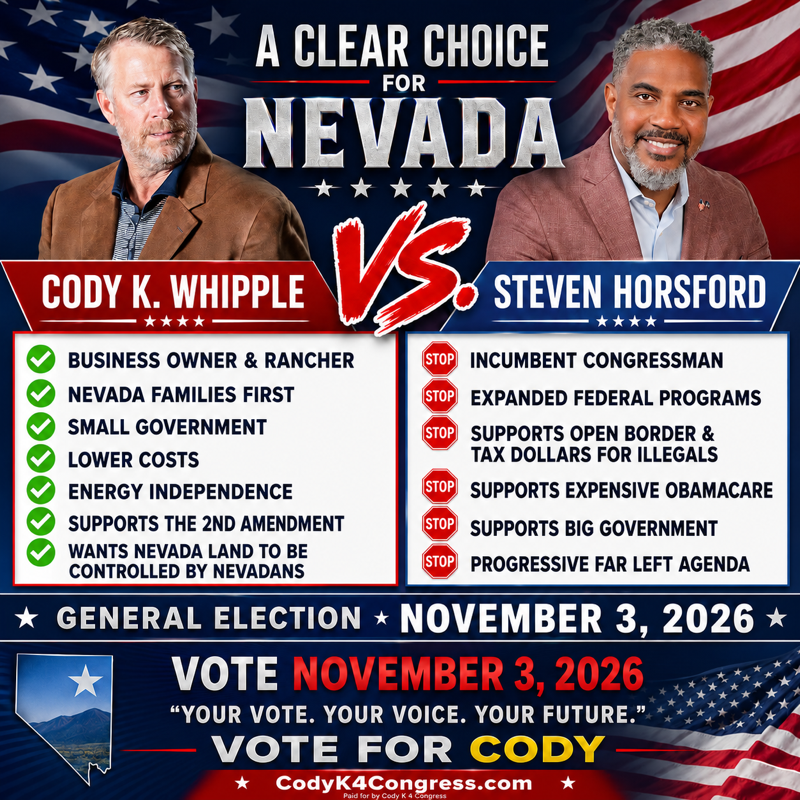
Cody Whipple, candidate for Nevada’s Congressional District 4, on the Veterans In Politics Talk Show
Cody Whipple, candidate for Nevada’s Congressional District 4, on the Veterans In Politics Talk Show