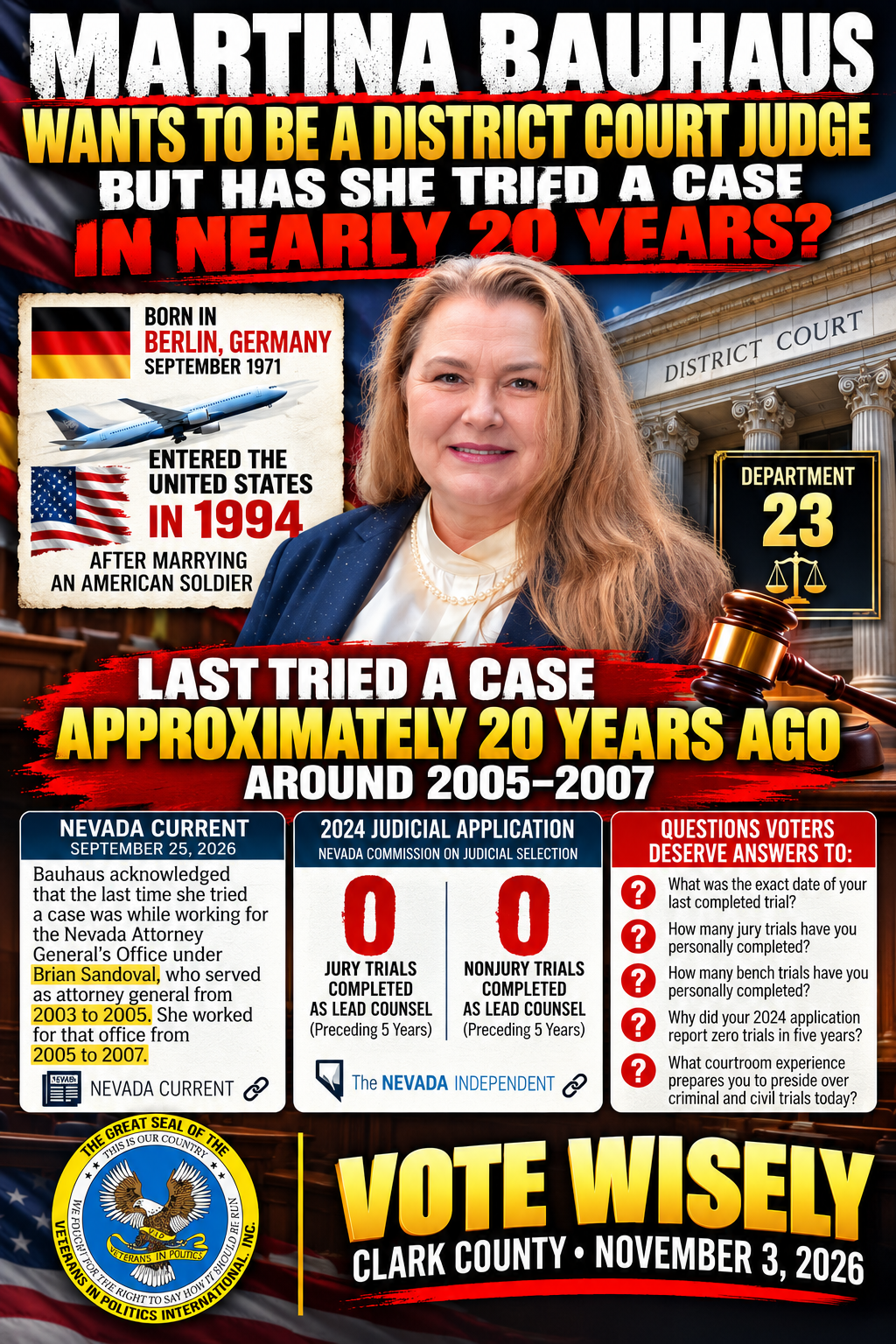
MARTINA BAUHAUS WANTS TO BE A DISTRICT COURT JUDGE — BUT HAS SHE TRIED A CASE IN NEARLY 20 YEARS?
Born in Germany, Arriving in America in 1994, and Building a Career Representing Law Enforcement: The Questions Clark County Voters Deserve Answered Before November 3, 2026
LAS VEGAS, NEVADA — October 26, 2026
When Clark County voters elect a District Court judge, they are choosing someone who will have tremendous authority over the lives of Nevada residents.
District Court judges preside over serious criminal prosecutions, complex civil lawsuits, constitutional disputes, and proceedings that can determine whether someone loses their freedom, property, or financial security.
Judges must understand the rules of evidence, courtroom procedures, constitutional protections, and the responsibilities of conducting fair and impartial trials.
That brings us to Martina Bauhaus, a longtime Las Vegas Metropolitan Police Department (LVMPD) attorney seeking election to Department 23 of Nevada’s Eighth Judicial District Court.
Bauhaus promotes more than 20 years of legal experience. But her public statements and judicial application raise an important question:
When was the last time Martina Bauhaus actually tried a case from beginning to end?
According to published reporting, the answer may be approximately two decades ago.
And that is something every Clark County voter deserves to examine.
1. MARTINA BAUHAUS: BORN IN GERMANY AND ARRIVED IN THE UNITED STATES IN 1994
Martina Bauhaus was reportedly born in Berlin, Germany, in September 1971.
According to her campaign biography and her responses to Ballotpedia’s 2026 Candidate Connection questionnaire, Bauhaus immigrated to the United States from Germany in 1994 after marrying an American soldier.
She describes herself as a first-generation American citizen.
Bauhaus has stated that she was raised by a single mother and later pursued higher education in Nevada.
She was admitted to the Nevada State Bar on April 20, 2005, under Bar Number 9337.
Bauhaus subsequently worked for the Nevada Attorney General’s Office before joining the Las Vegas Metropolitan Police Department in 2007.
Her immigration background is part of her publicly disclosed biography. It is not evidence of misconduct or a deficiency in her qualifications. Her citizenship is described in her own campaign materials, although the date of naturalization has not been independently established.
The issue deserving scrutiny is her courtroom and trial experience.
Sources:
Martina Bauhaus — Ballotpedia Candidate Biography
Martina Bauhaus — Official Campaign Website
State Bar of Nevada — Attorney Directory
2. THE NEARLY 20-YEAR QUESTION: WHEN WAS HER LAST TRIAL?
One of the most revealing statements about Bauhaus’s courtroom experience appeared in a September 25, 2026, article published by Nevada Current.
During the interview, Bauhaus acknowledged that the last time she tried a case was while working for the Nevada Attorney General’s Office under Brian Sandoval.
Sandoval served as Nevada Attorney General from January 6, 2003, until November 2, 2005.
Bauhaus was admitted to the Nevada Bar in April 2005 and reportedly worked for the Attorney General’s Office from 2005 through 2007.
Taken together, those facts suggest her last trial may have occurred in 2005, approximately 21 years before the November 3, 2026, general election.
However, the precise date, court, case number, and outcome have not been independently verified.
That raises a serious question: Why should voters be satisfied with general claims of extensive courtroom experience when the candidate has not publicly identified a completed trial from the past two decades?
It would be inaccurate to say that Bauhaus has never tried a case. But the public reporting identifies no more recent trial than her work under Sandoval.
Source: Nevada Current — September 25, 2026
3. HER OWN 2024 JUDICIAL APPLICATION REPORTED ZERO COMPLETED TRIALS AS LEAD COUNSEL
Perhaps the most significant information comes from Bauhaus’s own judicial application.
According to The Nevada Independent’s review of her 2024 Nevada Commission on Judicial Selection application, Bauhaus reported the following for the preceding five years:
ZERO jury trials completed as lead counsel.
ZERO nonjury trials completed as lead counsel.
These figures concern approximately 2019 through 2024, not her entire legal career.
The application also indicated that approximately 30 percent of her work involved trial-court litigation during that period.
Bauhaus explained that LVMPD frequently participates as a special party in interest rather than as a party she represents through an entire trial.
That explanation provides context, but it does not change the reported trial totals.
There is a fundamental difference between handling litigation and personally conducting a trial to its conclusion.
The first can involve extensive legal research, drafting motions, reviewing evidence, advising clients, and appearing at hearings.
The second requires direct responsibility for presenting a case, examining witnesses, handling objections, introducing evidence, and navigating trial proceedings.
Both forms of legal work are important.
But they are not identical.
Source: The Nevada Independent — 2026 Judicial Election, Department 23
4. YEARS REPRESENTING LVMPD — BUT HOW MANY TRIALS?
Bauhaus has worked for the Las Vegas Metropolitan Police Department since approximately 2007.
Her professional responsibilities have included litigation management, legal advice, detention-center matters, civil forfeiture, and other legal proceedings involving law enforcement.
According to Nevada Current, she has represented the jail for approximately 15 years.
Her responsibilities have included seeking judicial orders concerning involuntary medication for incarcerated individuals under circumstances involving safety concerns.
Such proceedings involve important legal and constitutional considerations, including bodily autonomy, due process, medical treatment, and institutional safety.
However, appearing before a judge to request an order is not necessarily the same as conducting a contested jury trial.
A lawyer may be highly experienced in motions, hearings, negotiations, and litigation management while having limited recent experience conducting trials.
The question is not whether Bauhaus has legal experience. She does.
The question is whether her experience adequately prepares her to preside over criminal and civil trials as a District Court judge.
That is a legitimate concern for voters to evaluate.
5. DISTRICT COURT IS NOT A TRAINING GROUND
Department 23 is a general-jurisdiction department of Nevada’s Eighth Judicial District Court.
Judges serving in such departments handle significant civil and criminal matters.
Their responsibilities can include ruling on constitutional motions, evaluating evidence, conducting jury selection, instructing jurors, and determining whether proceedings comply with applicable law.
These are not minor administrative duties.
A judge’s decisions can affect a defendant’s freedom, a family’s financial security, an individual’s property rights, or the outcome of a multimillion-dollar lawsuit.
Judges must be prepared to make difficult decisions in real time while protecting the rights of everyone appearing before them.
Should voters be concerned when a candidate’s last identified trial occurred approximately two decades ago?
That is a fair question.
There is no universal rule requiring a judicial candidate to have completed a particular number of jury trials. Attorneys from many different legal backgrounds can become capable judges.
Nevertheless, recent trial experience is a meaningful qualification voters may reasonably consider.
6. HER CAMPAIGN PROMOTES EXTENSIVE COURTROOM EXPERIENCE
Bauhaus’s campaign biography emphasizes her extensive legal and courtroom experience involving civil litigation and criminal matters.
But voters should examine what that description actually means.
How many criminal jury trials has she personally conducted?
How many civil jury trials has she personally conducted?
How many cases has she tried to a verdict or final judgment as lead counsel?
How many witnesses has she examined during a completed trial?
When was the last time she participated in jury selection?
When was the last time she delivered an opening statement or closing argument before a jury?
Her public biography does not provide a complete career trial count answering these questions.
Experience in litigation should be evaluated according to the work actually performed, not merely the number of years an attorney has held a legal position.
That standard should apply to every judicial candidate.
7. CIVIL RIGHTS, CONSTITUTIONAL PROTECTIONS, AND LAW ENFORCEMENT
Bauhaus’s professional background also deserves examination because she has spent much of her career representing a major law enforcement agency.
Her disclosed work includes matters involving detention-center inmates, civil litigation, involuntary medication, and civil forfeiture.
These proceedings can involve important constitutional questions.
For example, civil forfeiture proceedings can affect property rights and due process. Involuntary-medication proceedings can implicate significant liberty and bodily-integrity interests.
Her experience in these areas may provide valuable legal knowledge.
However, voters may reasonably ask how she would approach cases involving allegations of police misconduct, unconstitutional searches, excessive force, or violations of detainees’ rights.
The available public information does not establish that Bauhaus personally violated anyone’s civil rights, and the State Bar of Nevada lists no disciplinary actions against her.
The legitimate issue is whether she can demonstrate the independence, impartiality, and judicial judgment necessary to preside over disputes involving law enforcement and individual constitutional rights.
8. FIVE QUESTIONS MARTINA BAUHAUS SHOULD ANSWER BEFORE ELECTION DAY
Question One: What was the exact date of your last completed trial?
Identify the court, case number, judge, opposing counsel, and outcome.
Question Two: How many jury trials have you personally completed as lead counsel throughout your legal career?
Provide separate totals for criminal and civil trials.
Question Three: Why did your 2024 judicial application report zero completed jury trials and zero completed nonjury trials as lead counsel during the preceding five years?
What additional completed trials, if any, have you conducted since that application?
Question Four: How many trials have you personally conducted since joining LVMPD in 2007?
Distinguish completed trials from hearings, motions, and litigation-management responsibilities.
Question Five: What specific training and courtroom experience have prepared you to preside over serious criminal jury trials and complex civil litigation?
These are reasonable questions for someone seeking a position of considerable judicial authority.
They deserve specific answers.
9. VOTERS DESERVE MORE THAN A RESUME
Bauhaus’s professional history includes substantial legal work and years of government service.
Those qualifications deserve consideration.
But the public should also examine what is missing from the available trial record.
Her reported last trial dates to her early career in the Nevada Attorney General’s Office.
Her 2024 judicial application reported no completed jury or nonjury trials as lead counsel during the preceding five years.
And the public information reviewed does not identify a more recent completed trial.
A long legal career is not automatically the same as a long trial career.
That distinction matters when the office being sought involves presiding over trials.
Judicial candidates should welcome scrutiny of their qualifications, especially when asking voters to entrust them with authority over the rights and freedoms of others.
CONCLUSION: BEFORE MARTINA BAUHAUS PRESIDES OVER YOUR TRIAL, SHOULDN’T VOTERS KNOW WHEN SHE LAST CONDUCTED ONE?
Martina Bauhaus came to the United States from Germany in 1994, pursued higher education in Nevada, became a licensed attorney in 2005, and built a long career in government legal work.
Those are documented elements of her professional and personal biography.
But her candidacy for Department 23 raises an important question about her trial experience.
Her last reported trial appears to have occurred approximately 20 years ago.
Her 2024 judicial application reported zero completed jury trials and zero completed nonjury trials as lead counsel during the preceding five years.
These facts do not establish that Bauhaus is incapable of serving as a judge. They do establish an important subject for voter scrutiny.
The voters of Clark County deserve transparency about the actual trial experience of every candidate seeking judicial office.
A District Court judge must be prepared to safeguard constitutional rights, manage difficult proceedings, and administer justice impartially.
Before voters make their decision on November 3, 2026, Martina Bauhaus should provide a clear, documented answer to the question at the center of her candidacy:
WHEN WAS THE LAST TIME YOU ACTUALLY TRIED A CASE?
SOURCES AND PUBLIC RECORDS
1. Nevada Current — September 25, 2026
LVMPD Attorney Seeks to Unseat Judge in Clark County District Court Race
Reporting on Bauhaus’s career, immigration background, LVMPD employment, and statements concerning her last trial.
2. The Nevada Independent — 2026 Judicial Election Guide
District Court Judge, Eighth Judicial District, Department 23
Candidate information, legal background, 2024 judicial application disclosures, and reported trial statistics.
3. Ballotpedia — Martina Bauhaus
Candidate Biography and 2026 Candidate Connection Questionnaire
Her account of immigrating from Germany in 1994, educational background, citizenship, and campaign positions.
4. Martina Bauhaus Campaign Website
Official Campaign Biography
Her published description of her immigration history, professional experience, and judicial philosophy.
5. Nevada Attorney General’s Office
Official Biography — Former Attorney General Brian Sandoval
Official confirmation that Sandoval served as Nevada Attorney General from January 6, 2003, through November 2, 2005.
6. State Bar of Nevada
Martina Bauhaus — Attorney Registration
Confirmation of her April 20, 2005, bar admission, active attorney status, and publicly listed disciplinary history.
Research clarification: Bauhaus’s arrival in the United States in 1994 is supported by her own published statements. Berlin is her reported birthplace, but an independent birth record has not been verified. Her precise last trial date and complete career trial count remain unverified. The approximately 20-year estimate is based on her statements about working under Attorney General Brian Sandoval and her documented professional chronology.