Running for Henderson, Campaigning for Carson City: Jennifer Atlas’s Lobbying Record Deserves Scrutiny
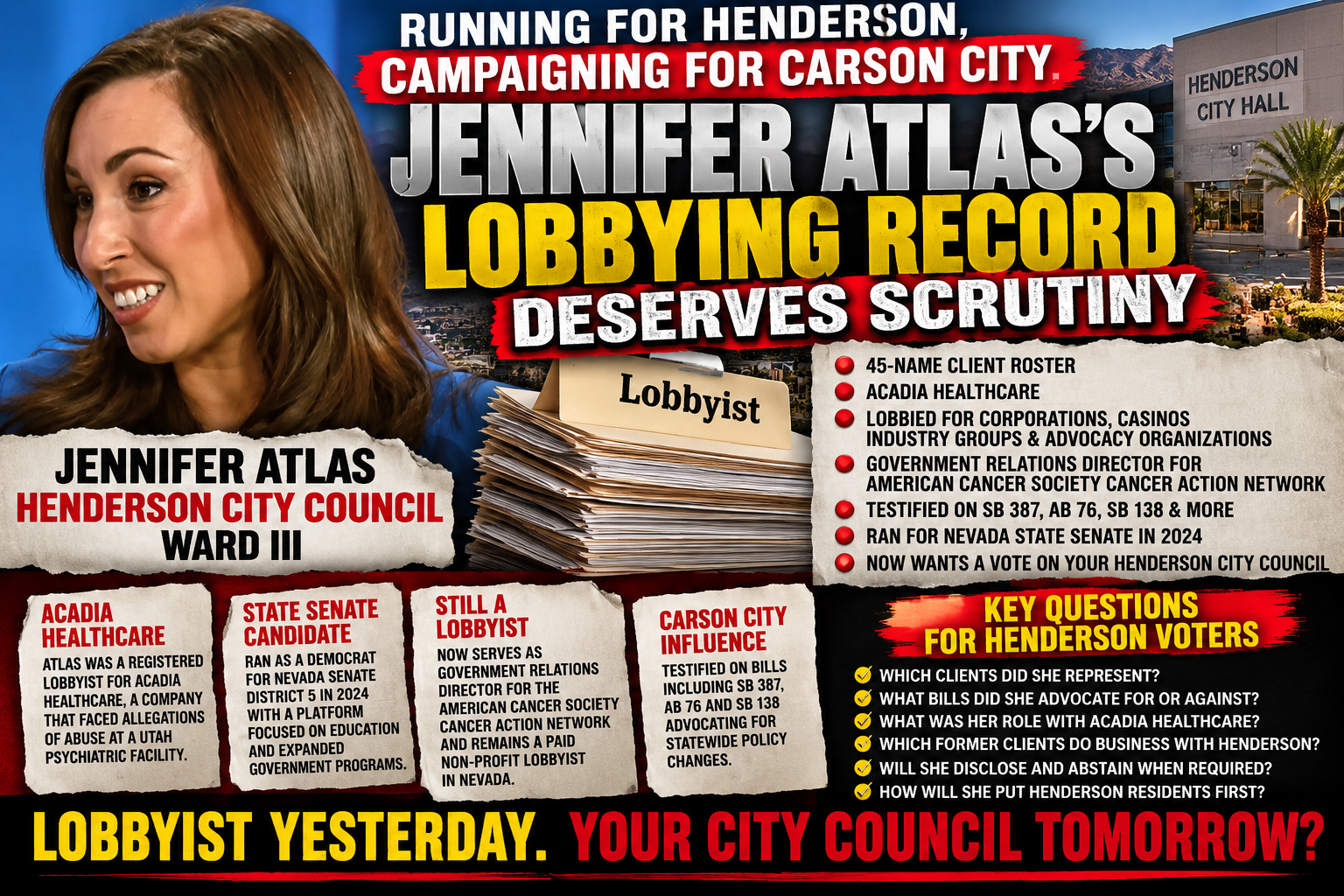
Jennifer Atlas is seeking a seat on the Henderson City Council in Ward III. Her résumé, however, includes substantial experience in state politics and government relations: she ran for the Nevada Senate in 2024, previously worked as a lobbyist, and now serves as government relations director for the American Cancer Society Cancer Action Network.
Those experiences may help Atlas understand how government works. Henderson voters can also reasonably examine how that background, her former lobbying clients and her current advocacy work could inform her approach at City Hall.
Atlas is now one of the two candidates advancing to the November 2026 general election for Henderson City Council Ward III. The Nevada Independent reported that Atlas advanced with incumbent Councilwoman Carrie Cox. (thenevadaindependent.com)
FROM STATE SENATE CANDIDATE TO HENDERSON CITY COUNCIL
Atlas ran as a Democrat for Nevada Senate District 5 in 2024 against Republican incumbent Carrie Buck. Contemporary election coverage identifies Atlas as the Democratic candidate in that race. (lasvegassun.com)
Her campaign emphasized issues that included education and working families. The Democratic Legislative Campaign Committee, which supported her candidacy, described reducing class sizes and increasing teacher pay as among her priorities. That description represents the Democratic organization’s characterization of her campaign, not an independent assessment of Atlas. (dlcc.org)
Atlas lost the 2024 general election and has now turned her attention to municipal government.
That transition raises a legitimate question for Ward III voters: How much of Atlas’s state-level political and lobbying experience would carry into the decisions she would make on the Henderson City Council?
THE LOBBYING RECORD
Before her current position, Atlas worked in lobbying and public affairs.
During the 2024 Senate campaign, The Nevada Independent described her as having transitioned from hospitality into lobbying and reported that she was no longer working as a lobbyist at that time and was instead employed as a paralegal. (thenevadaindependent.com)
Materials supplied for this article show a substantially broader historical client roster associated with Atlas’s lobbying work. The photographs list corporations, casinos, industry organizations, public entities, health-care interests and advocacy organizations.
A client listing establishes that a lobbyist was registered or identified to represent a client during the relevant reporting period. It does not, by itself, establish what specific position the lobbyist took on every bill, how much the lobbyist was paid, whether the client supported every action taken by the lobbyist, or that the organization remains a client today.
Those distinctions matter.
The client list nevertheless provides relevant context for voters evaluating a candidate whose professional background includes government relations and lobbying.
ACADIA HEALTHCARE
One of the names associated with Atlas’s past lobbying work that received particular attention during her 2024 Senate campaign was Acadia Healthcare.
The Nevada Independent reported that Republicans criticized Atlas over past lobbying clients including Acadia Healthcare. The newspaper noted that subsidiaries of the company had faced controversies, including litigation involving allegations of sexual abuse at a Utah psychiatric facility that Acadia owned and later closed. (thenevadaindependent.com)
The Nevada Globe also reported during the 2024 campaign that Atlas had been listed as a lobbyist for Acadia Healthcare. (thenevadaglobe.com)
That history should be presented carefully. Representation of a corporation as a lobbyist does not establish personal responsibility for misconduct alleged against that corporation or its subsidiaries.
The appropriate question for voters is narrower: What work did Atlas perform for Acadia Healthcare, what legislation or governmental matters did that representation involve, and what positions did she advocate on the company’s behalf?
Those are questions that can be answered with lobbying records, legislative testimony and Atlas’s own explanation.
A LOBBYIST IS NOT A LEGISLATOR
There is another important distinction.
A registered lobbyist does not cast votes in the Nevada Legislature.
Lobbyists advocate, communicate with lawmakers, testify, provide information and attempt to influence public policy on behalf of their employers or clients. Legislators are the officials who ultimately vote on legislation.
Therefore, it would be inaccurate to characterize a lobbying position as a legislative vote by Atlas.
When reviewing legislation connected to one of Atlas’s clients—including SB 251 or other measures—the relevant inquiry is whether Atlas was registered for the client, whether she testified or otherwise publicly advocated regarding the legislation, and what position the client or lobbyist actually took.
Those facts should not be converted into a claim that Atlas personally “voted” for or against legislation when she was not serving as a legislator.
BACK IN CARSON CITY
Atlas returned to the government-relations world in 2025.
The American Cancer Society Cancer Action Network announced on February 19, 2025, that Atlas had become its Government Relations Director in Nevada.
ACS CAN said Atlas would lead its Nevada efforts to advance legislation and public policies intended to reduce the cancer burden. The organization also reported that Atlas had already testified against AB 76, legislation that would have permitted cannabis smoking in designated consumption lounges under changes to Nevada’s Clean Indoor Air Act. (fightcancer.org)
Nevada’s official lobbyist registry currently identifies Jennifer Atlas as a Paid Non-Profit lobbyist representing the American Cancer Society Cancer Action Network. (leg.state.nv.us)
That means Atlas’s current professional duties continue to involve public-policy advocacy.
Her campaign website likewise says she works for ACS CAN advocating for policies affecting patients and families. (atlasfornevada.com)
HER 2025 LEGISLATIVE ADVOCACY
Atlas’s government-relations work can also be found directly in Nevada legislative records.
For example, minutes of the Assembly Committee on Commerce and Labor from April 23, 2025 identify Atlas as Government Relations Director for ACS CAN. She testified concerning SB 387, explaining ACS CAN’s position regarding insurance coverage for lung-cancer screening and follow-up testing. (archive.leg.state.nv.us)
The Nevada Independent has also reported that Atlas was involved with SB 138, legislation addressing presumptive Medicaid enrollment for eligible pregnant women. (thenevadaindependent.com)
These activities are not inherently improper. Government-relations professionals routinely advocate before legislatures.
But Atlas is no longer simply a lobbyist or advocacy professional. She is asking Henderson residents to elect her to public office.
That makes transparency concerning her professional advocacy especially important.
WHAT DOES THIS HAVE TO DO WITH HENDERSON?
Henderson City Council members make decisions involving development, public safety, land use, contracts, businesses, taxation and fees, redevelopment, infrastructure and other matters involving private and public interests.
Atlas says her campaign is focused on Henderson families. Her campaign biography states that she wants families to have a voice at City Hall and emphasizes her experience as a mother and advocate. (atlasfornevada.com)
She has also criticized some Henderson spending priorities.
The Nevada Current reported that Atlas questioned expensive city projects, including Henderson’s purchase of the former Fiesta Henderson parking garage, and said public safety should come first. She said law enforcement should have the resources it needs before the city pursues other projects. (nevadacurrent.com)
Those are municipal issues.
But voters are entitled to look beyond campaign messaging and examine a candidate’s entire professional record.
THE 45-NAME CLIENT ROSTER
The photographs provided for this article show approximately 45 names associated with Atlas’s lobbying history.
That is significant enough to warrant examination, but the list needs to be interpreted correctly.
The existence of a name on a lobbying disclosure does not prove wrongdoing. Nor does it mean Atlas personally agreed with every policy position ever taken by every organization she represented.
It also should not be represented as her current client list unless current lobbying records establish that fact.
Instead, the roster provides a roadmap for further examination.
For each organization, voters and journalists can ask:
What was Atlas hired or retained to advocate for?
What bills or governmental actions involved the client?
Did Atlas testify publicly?
What position did she take?
Were any of those matters relevant to Henderson?
Could any former or current professional relationship intersect with matters that may come before the Henderson City Council?
Those questions are more informative than simply attaching labels to a candidate.
FROM ADVOCATE TO DECISION-MAKER
Lobbying and government relations are about influencing government decisions.
Serving on the Henderson City Council is different.
A council member becomes one of the people making those decisions.
That distinction makes disclosure particularly important.
If elected, Atlas could encounter matters involving industries, organizations or interests with which she has had professional relationships. Nevada ethics law and Henderson’s applicable ethics rules would determine when disclosure, abstention or another action is legally required.
Voters do not have to assume a conflict exists merely because a former client appears before the city.
But voters can reasonably expect transparency about those relationships.
QUESTIONS WARD III VOTERS CAN ASK
Atlas’s lobbying and advocacy experience creates a substantial public record that voters can examine.
Among the factual questions worth asking are:
-
Which organizations did Atlas personally represent during her lobbying career?
-
What legislation did she advocate for or against for those clients?
-
What exactly was her role representing Acadia Healthcare?
-
Which of her former clients do business with, seek approvals from, contract with or otherwise interact with the City of Henderson?
-
What relationships, if any, remain active?
-
What circumstances would cause Atlas to disclose a prior professional relationship or abstain from a City Council matter?
-
How does she distinguish her responsibilities to past or present advocacy employers from her responsibilities to Henderson residents if elected?
-
Why did she move from a Nevada Senate campaign in 2024 to a Henderson City Council campaign in 2026, and what does she view as the proper role of municipal government?
Atlas should have the opportunity to answer those questions directly.
THE ISSUE IS TRANSPARENCY
There is nothing inherently disqualifying about having worked as a lobbyist.
Lobbyists can possess extensive knowledge of legislation, regulatory systems and government.
That experience can be useful in elected office.
It also creates a professional record that voters have every right to examine.
Jennifer Atlas is asking Henderson residents to entrust her with a vote on the City Council. Her record should therefore be evaluated based on documented facts: whom she represented, what policies she advocated, what positions she has taken as a candidate and what she proposes to do in Henderson.
The issue should not be guilt by association.
The issue should be transparency, disclosure and accountability.
Ward III voters can review the record, hear Atlas’s explanations and decide for themselves how much weight her lobbying and government-relations background should carry when they cast their ballots.
SOURCES
Nevada Legislature — 2025 Interim Lobbyist Registry
The official state registry lists Jennifer Atlas as a paid nonprofit lobbyist for the American Cancer Society Cancer Action Network.
Nevada Legislature Lobbyist Registry
American Cancer Society Cancer Action Network — February 19, 2025
Announcement naming Jennifer Atlas Government Relations Director in Nevada and describing her legislative advocacy responsibilities.
ACS CAN announcement on Jennifer Atlas
American Cancer Society Cancer Action Network — Nevada
Current Nevada advocacy information and state contact information identifying Atlas as Government Relations Director.
ACS CAN Nevada
Nevada Legislature — Assembly Committee on Commerce and Labor, April 23, 2025
Official committee minutes recording Atlas’s testimony on behalf of ACS CAN concerning SB 387.
Nevada Legislature committee minutes
The Nevada Independent — Henderson Ward III candidate profile
Reporting on Atlas’s professional background, campaign and involvement with SB 138.
Meet the Henderson council candidates
The Nevada Independent — 2026 Primary Election
Reporting on Atlas and Cox advancing from the Ward III primary to the general election.
Clark County 2026 primary election coverage
The Nevada Independent — 2024 Senate District 5 Candidate Interviews
Background on Atlas’s lobbying career, Acadia Healthcare controversy and 2024 Senate campaign.
Senate District 5: Carrie Buck and Jennifer Atlas
Nevada Current — Henderson Ward III Race
Reporting on Atlas’s criticism of Henderson spending priorities and statements concerning public safety.
Henderson Ward III election coverage
Jennifer Atlas Campaign Website
Atlas’s own biography and description of her current ACS CAN advocacy work.
Jennifer Atlas for Ward III
Nevada Globe — August 12, 2024
Reporting concerning Atlas’s prior representation of Acadia Healthcare. This is included as a source for that specific claim and should be considered alongside independent and official records.
Nevada Globe report on Atlas and Acadia Healthcare
Democratic Legislative Campaign Committee — July 2, 2024
The Democratic organization’s description of Atlas’s 2024 Nevada Senate campaign priorities.
DLCC 2024 Nevada candidate announcement