
STOLEN VALOR OR STOLEN CREDIBILITY? THE “COMMANDER” WHO NEVER SERVED: ANDRE HAYNES AND THE ARMED FORCES CHAMBER UNDER SCRUTINY
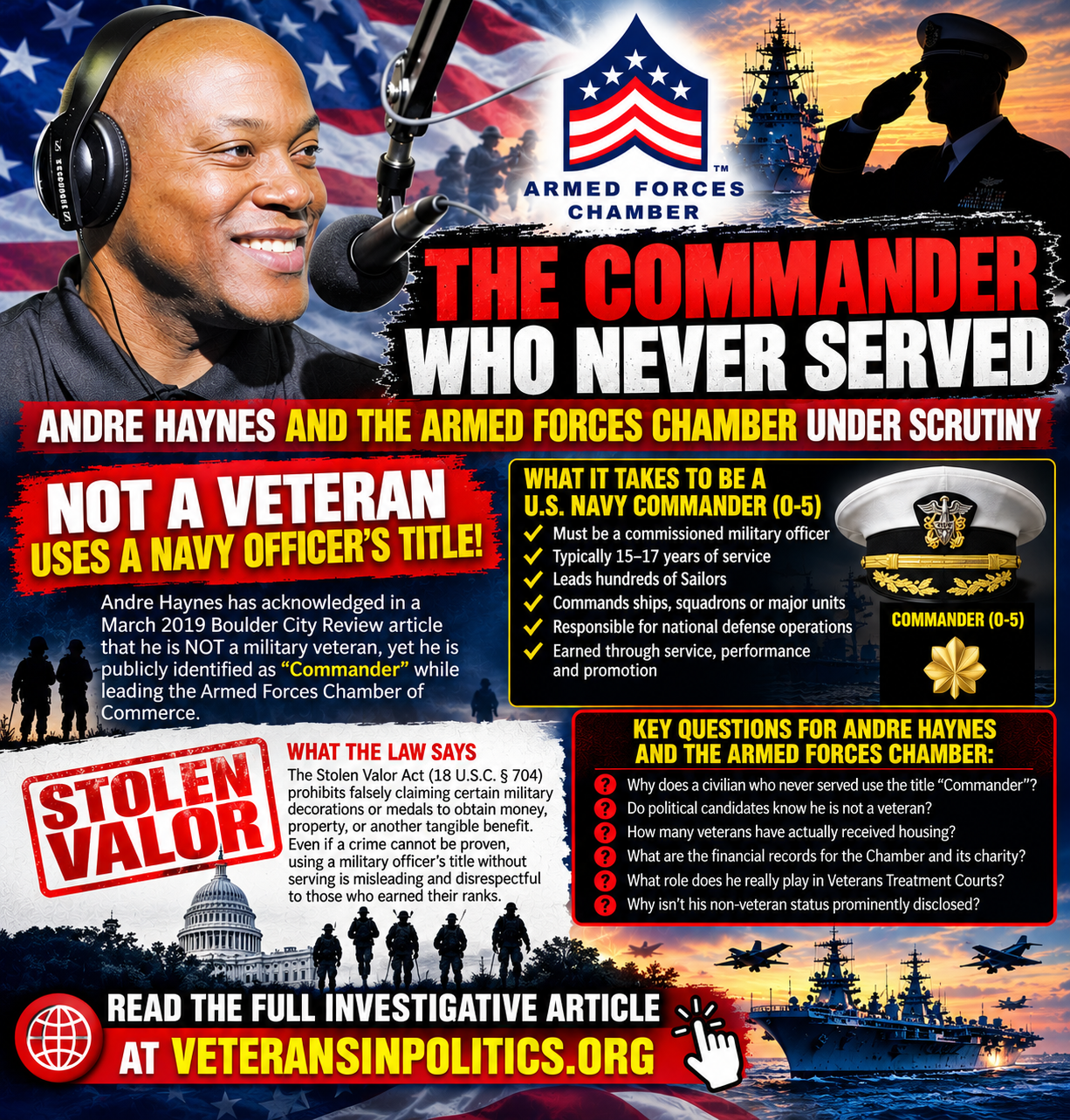
Veterans In Politics International Questions the Use of a Military Officer’s Title by a Civilian Leader Involved in Political Endorsements, Veterans Treatment Courts, and Veterans Housing
LAS VEGAS, NEVADA — October 29, 2026
He is called “Commander Andre Haynes.” He founded the Armed Forces Chamber of Commerce. His organization endorses political candidates and promotes involvement in Veterans Treatment Courts, veterans housing, and military-related community programs.
But Andre Haynes has never served in the United States military.
That is the central fact every Nevada veteran, political candidate, elected official, charitable donor, and community leader should understand.
Haynes acknowledged his non-veteran status in a March 2019 Boulder City Review article. His civilian status was reported again in December 2023.
Yet public materials have continued to identify him as “Commander.”
Veterans In Politics International believes this raises a serious ethical question: Why should a civilian who never served in uniform use a title identical to a senior United States Navy officer’s rank while leading an organization that trades on military identity and credibility?
The controversy also raises questions about Stolen Valor, political influence, transparency, and the distinction between supporting veterans and representing them.
1. ANDRE HAYNES IS NOT A VETERAN — THE PUBLIC DESERVES TO KNOW
In a March 27, 2019, article published by the Boulder City Review, Haynes acknowledged that he was not a veteran, explaining that members of his family had served in the military.
In December 2023, the newspaper again reported that Haynes was not a veteran while covering the Chamber’s charitable activities.
This is an established fact, not an accusation.
Haynes has acknowledged his civilian status publicly. However, Veterans In Politics International questions whether that distinction is sufficiently prominent in the Chamber’s public identity and introductions.
A person should not have to research old newspaper articles to understand whether someone introduced as Commander actually served in the military.
There is nothing dishonorable about being a civilian. There is nothing wrong with civilians supporting military families.
The issue is whether a civilian leader’s use of a military-sounding title creates an impression of service or rank that he does not possess.
Sources:
-
Boulder City Review — Armed Forces Chamber Serves Veterans, Military
-
Boulder City Review — Veterans Promote 7th Annual Christmas Toy Giveaway
2. WHAT DOES IT ACTUALLY TAKE TO BECOME A UNITED STATES NAVY COMMANDER?
Commander is not an entry-level military position. It is a senior commissioned officer rank in the United States Navy, designated O-5.
It sits above Lieutenant Commander (O-4) and below Captain (O-6). Its equivalent in the Army, Marine Corps, and Air Force is Lieutenant Colonel.
Becoming a Navy Commander generally requires an extensive military career.
A prospective officer ordinarily must first qualify for a commission through an authorized pathway, such as the United States Naval Academy, Naval Reserve Officers Training Corps, Officer Candidate School, or another approved commissioning program.
Commissioned officers then serve in progressively responsible military assignments.
Their careers are evaluated through performance, leadership, professional qualifications, and promotion processes.
According to the Navy’s published promotion guidance, the average promotion flow point for O-5 is approximately 15 to 17 years of commissioned service, although actual timelines vary.
A Navy Commander has normally spent many years developing the experience and qualifications necessary to hold senior leadership responsibilities.
Andre Haynes has not completed that military career. He has not earned the rank of Commander in the United States Navy.
Sources:
-
U.S. Navy — Officer Ranks and Insignia
-
U.S. Navy — Becoming a Commissioned Officer
-
MyNavyHR — Officer Promotion Guidance
3. THE JOB DESCRIPTION OF A REAL NAVY COMMANDER
A Navy Commander can hold responsibility for hundreds of service members, critical equipment, and complex military operations.
Depending on the officer’s specialty and assignment, a Commander may lead a destroyer, submarine, aviation squadron, major department, or shore activity.
A Commander’s responsibilities may include:
-
Military leadership: Directing Sailors and subordinate officers while maintaining accountability for personnel and mission performance.
-
Operational readiness: Ensuring that assigned units, equipment, and personnel are prepared to execute military missions.
-
Mission execution: Planning and supervising naval operations, exercises, deployments, and other assigned responsibilities.
-
Personnel management: Evaluating, mentoring, developing, and supervising military personnel.
-
Discipline and standards: Enforcing applicable military regulations, professional standards, and command responsibilities.
-
National defense: Carrying out lawful orders and military missions in support of United States national security.
Not every Commander commands a ship or combat unit, but every actual Navy Commander holds a military commission and the corresponding rank.
The rank reflects an officer’s military career and legal status, not simply a title used within a civilian organization.
A chamber of commerce cannot commission someone into the United States Navy.
It cannot grant an O-5 rank.
It cannot create the military service history required to earn that rank.
And it cannot turn a civilian into a veteran simply by giving that person a title.
Source: U.S. Navy — Ranks and Responsibilities
4. STOLEN VALOR: WHAT THE LAW ACTUALLY SAYS
The term Stolen Valor commonly describes misrepresentations about military service, rank, awards, or accomplishments.
For veterans who served honorably, the issue is deeply personal.
The United States military awards ranks and decorations based on specific qualifications, service, performance, and accomplishments.
However, there is an important difference between conduct that people criticize as stolen valor and conduct that violates federal criminal law.
The Stolen Valor Act of 2013
The Stolen Valor Act of 2013 amended 18 U.S.C. § 704.
Under the relevant federal provision, criminal liability can arise when someone fraudulently represents themselves as a recipient of certain military decorations or medals with intent to obtain money, property, or another tangible benefit.
The law specifically addresses qualifying military decorations and medals. It is not a general prohibition on every civilian use of a military-associated title.
A person does not automatically violate the Stolen Valor Act merely by using the word Commander.
Nor does founding a military-themed organization, without more, establish a Stolen Valor violation.
There is currently no verified evidence presented in this investigation that Haynes falsely claimed a covered military decoration or medal or committed a federal Stolen Valor offense.
Nevertheless, Veterans In Politics International believes his use of the Commander title raises a legitimate question about the broader ethical principle behind stolen valor: protecting the public from misleading representations of military status and achievements.
We believe the community is entitled to ask whether the title has caused people to mistake Haynes for a military officer or veteran.
Sources:
5. “COMMANDER ANDRE HAYNES”: HOW DID A CIVILIAN TITLE BECOME PART OF HIS PUBLIC IDENTITY?
Public materials have identified Haynes as Commander, including references associated with United Way of Southern Nevada, the Las Vegas–Clark County Library District, and Veterans World Magazine.
A December 31, 2025, Library District community engagement report used the description “Commander Andre Haynes of the Armed Forces Chamber.”
The significance is that the title appears outside the Chamber’s own internal communications.
It has become part of the way Haynes is presented to the broader community.
The public record reviewed does not establish who originally created the title, whether Haynes personally directs people to use it, or whether he has explicitly represented himself as a Navy officer.
Those facts deserve investigation.
But the public should not be left to guess whether “Commander Andre Haynes” refers to a military officer or a civilian organizational leader.
We believe every public introduction should include a clear explanation of his civilian status.
6. VETERANS IN POLITICS PERSONALLY ADDRESSED THE ISSUE WITH HAYNES
Veterans In Politics International leadership states that it has personally confronted Andre Haynes regarding the Commander title and its potential to mislead the public.
We expressed our concerns directly.
We believe it is disrespectful to military veterans when a civilian leader of a military-themed organization uses a title identical to a senior naval rank without making its civilian meaning unmistakably clear.
Despite our objections, the title has continued to appear in public descriptions of Haynes.
We question why that practice continues.
If the title is merely an internal designation, why not clearly identify it as such every time it is used?
Why not prominently state that Haynes has never served in the military?
Why should veterans, candidates, and elected officials have to investigate his background to determine whether he possesses military credentials?
The solution is simple: complete transparency.
7. POLITICAL ENDORSEMENTS: ARE CANDIDATES CONFUSING A CIVILIAN CHAMBER WITH A VETERANS ORGANIZATION?
The Armed Forces Chamber has participated in political endorsements through its associated political action committee.
Political endorsements can carry substantial influence, particularly when an organization’s name references the Armed Forces.
Candidates may seek such endorsements to demonstrate support from veterans, military families, or veteran-owned businesses.
But an endorsement from the Armed Forces Chamber should not automatically be interpreted as an endorsement from military veterans collectively.
Nor should a candidate assume that its founder served in uniform.
Veterans In Politics International believes candidates should ask whether the Chamber’s endorsing representatives are veterans, how endorsement decisions are made, and whether those decisions reflect a documented membership vote or a smaller leadership process.
A military-themed organizational name does not automatically establish military experience, and a civilian title does not establish military rank.
There is no verified finding here that Haynes deceived a particular candidate or improperly obtained an endorsement-related benefit.
However, candidates should have accurate information before presenting Chamber endorsements to voters.
8. VETERANS TREATMENT COURTS: WHY MILITARY CREDIBILITY MATTERS
Veterans Treatment Courts address the needs of justice-involved veterans, often coordinating treatment, supervision, mentoring, and access to services.
These programs can involve judges, attorneys, treatment professionals, veteran mentors, and community partners.
The Armed Forces Chamber has publicized involvement in veterans-related programs, including activities associated with Veterans Treatment Courts.
Civilian participation in these programs can be valuable and entirely appropriate.
Nevertheless, the distinction between a military veteran and a civilian supporter is especially important in settings where military experience may carry credibility.
Someone who has never served should not be mistaken for someone who personally understands military life through service.
We believe court officials and community partners should know whether a person introduced as Commander holds an actual military rank or a civilian organizational title.
That disclosure protects veterans, court programs, and the integrity of community partnerships.
We are not alleging that Haynes improperly controls a Veterans Treatment Court or has received an unauthorized appointment. No such finding has been established.
Our demand is transparency.
9. VETERANS HOUSING: ACCOUNTABILITY MUST COME BEFORE TITLES
The Armed Forces Chamber has promoted veterans housing activities, including a project in Pahrump.
A December 2023 Veterans World Magazine article discussed Haynes’s veterans-related charitable efforts and housing initiatives.
Those activities deserve evaluation based on their actual results.
How many veterans received housing?
How much money was raised?
How much was spent on direct services?
Were promised facilities completed?
What independent oversight exists?
And do the donors, government partners, and veterans receiving services understand that Haynes is a civilian?
These questions should be answered through documents, financial reports, project records, and verifiable outcomes.
We are not asserting that housing funds were misappropriated or that promised services were never delivered.
But an impressive title should never substitute for financial transparency and documented accomplishments.
10. OUR DIRECT CHALLENGE TO ANDRE HAYNES
Veterans In Politics International calls upon Haynes to publicly answer these questions:
-
Who established the Commander title within the Armed Forces Chamber, and when?
-
Does Haynes personally request or encourage others to address him as Commander?
-
Does he clearly explain that he has never served in the United States military?
-
Has he ever been introduced as a Navy Commander or military veteran without correcting the description?
-
Have any political candidates or government officials mistaken his organizational title for actual military rank?
-
What role does he personally hold in Veterans Treatment Court activities and veterans housing programs?
-
Will the Chamber publish its membership figures, endorsement procedures, and financial information?
-
Will Haynes publicly commit to distinguishing his civilian organizational title from a military officer’s rank in all future communications?
These are reasonable questions about public accountability.
We invite Haynes to respond with documentation and an explanation of his position.
11. OUR MESSAGE TO THE VETERANS COMMUNITY
Veterans In Politics International has spent decades advocating for veterans, judicial accountability, political transparency, and the integrity of public institutions.
We understand the importance of military service and the sacrifices made by the men and women who wore our nation’s uniforms.
We also recognize the important contributions of civilian supporters.
But those two forms of service should not be confused.
Military rank is earned through military service. Organizational leadership is obtained through a civilian organization’s own procedures. They are not interchangeable.
Andre Haynes may legitimately serve as founder or leader of the Armed Forces Chamber of Commerce.
He may lawfully support veterans, organize charitable programs, and participate in political endorsements.
But he has never earned the United States Navy rank of Commander.
That fact should be made clear wherever his civilian title is used.
FINAL WORD: YOU CAN FOUND A CHAMBER — BUT YOU CANNOT APPOINT YOURSELF A UNITED STATES NAVY COMMANDER
There is no dishonor in never having served in the military.
There is no dishonor in being a civilian advocate for veterans.
The concern arises when military imagery, organizational branding, and an officer’s title create an impression of military credentials that the individual does not possess.
Veterans In Politics International believes that using Commander in this setting without an unmistakable civilian qualification risks misleading the public and diminishing the distinction between military rank and organizational title.
We do not claim that Haynes has been convicted of stolen valor or that his conduct has been proven to violate the Stolen Valor Act.
We do insist that the veteran community deserves clarity.
Andre Haynes is not a military veteran. He is not a United States Navy Commander. He is a civilian founder of the Armed Forces Chamber of Commerce who has been publicly identified by the title Commander.
Every candidate, elected official, charitable donor, veteran, and member of the community should know that distinction.
YOU CAN GIVE YOURSELF AN ORGANIZATIONAL TITLE. YOU CANNOT GIVE YOURSELF A MILITARY CAREER.
Military service is earned. Military rank is earned. Respect for those who served must be protected.
Veterans In Politics International, Inc.
Investigative Editorial — October 29, 2026
This editorial distinguishes documented facts from the organization’s opinions, concerns, and unanswered questions. The discussion of Stolen Valor does not constitute an allegation or finding of a criminal offense. Andre Haynes and the Armed Forces Chamber are invited to respond.
Sources
-
Boulder City Review — Armed Forces Chamber Serves Veterans, Military
-
Boulder City Review — Veterans Promote 7th Annual Christmas Toy Giveaway
-
U.S. Navy — Official Ranks and Insignia
-
U.S. Navy — Becoming a Commissioned Officer
-
MyNavyHR — Officer Promotion Guidelines
-
United States Code — 18 U.S.C. § 704
-
Congress — Stolen Valor Act of 2013
-
Armed Forces Chamber — Official Website
-
ProPublica — Armed Forces Chamber Community Development Corporation
-
Nevada Secretary of State