A documented record of Proud Boys ties, Republican infighting, threats and political spectacle raises uncomfortable questions about what Paul Laramie actually brings to Nevada politics.
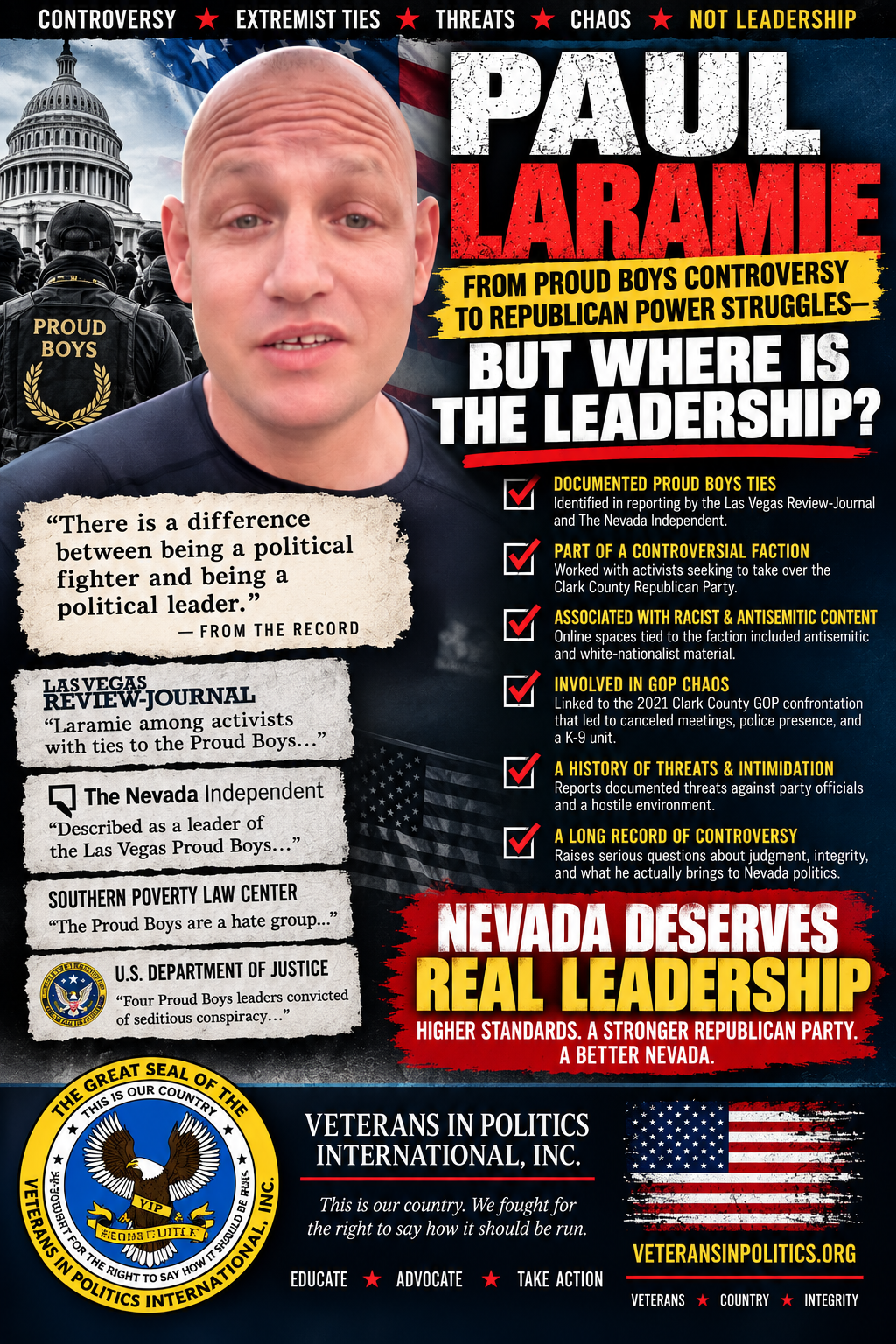
There is a difference between being a political fighter and being a political leader.
Paul Laramie has spent years cultivating the image of the former. His name repeatedly surfaced during one of the ugliest periods of internal warfare in Nevada Republican politics, when activists associated with the Las Vegas Proud Boys sought greater influence inside the Clark County Republican Party.
That history is not a matter of partisan rumor.
It was reported by the Las Vegas Review-Journal and The Nevada Independent. Those reports identified Laramie as one of the principal figures in a faction with Proud Boys connections that was attempting to reshape Clark County Republican leadership.
The question, then, is not whether Laramie has been controversial.
He has.
The more serious question is what that controversy has produced.
The Proud Boys connection cannot simply be waved away
The most consequential fact in Laramie’s political record is his documented association with the Las Vegas Proud Boys.
The Nevada Independent described Laramie as a leader of the Las Vegas Proud Boys. The Review-Journal likewise reported that Laramie was among activists with ties to the organization who were seeking positions of influence inside the Clark County GOP.
That matters because the Proud Boys are not simply another conservative club.
The Southern Poverty Law Center designates the Proud Boys as a hate group and describes the organization as a far-right extremist organization whose members have engaged in violence and harassment.
More importantly, this is not merely a classification made by an advocacy organization.
The U.S. Justice Department prosecuted senior Proud Boys leaders for their conduct surrounding January 6, 2021. Four leaders were convicted of seditious conspiracy, and former national chairman Enrique Tarrio was later sentenced to 22 years in federal prison. The Justice Department said evidence at trial established that Proud Boys leaders conspired to oppose the lawful transfer of presidential power by force.
That does not mean Laramie participated in January 6, nor does the available evidence establish that he committed any crime connected to the Capitol attack.
Those distinctions matter.
But they also make his reported affiliation with the organization a legitimate subject of political scrutiny.
And then there is the racism and antisemitism controversy
This is where the record becomes particularly uncomfortable.
The Review-Journal reported that the online faction surrounding the Nevada activists contained antisemitic material and that its members had ties to the Proud Boys. The Nevada Independent likewise described the Clark County confrontation as being driven in part by associates of the Proud Boys.
Contemporary reporting described online material associated with the faction as including antisemitic and white-nationalist imagery and rhetoric. One report cited material depicting Jews through antisemitic stereotypes and material involving Adolf Hitler.
That is serious.
But precision is essential: the sources reviewed here do not establish that Laramie personally authored every racist or antisemitic post attributed to the online groups or that he personally endorses every item posted there.
A responsible investigation should not turn association into proof of personal authorship.
The harder and more defensible question is this:
What responsibility does a political activist have when he operates within a political faction whose associated online spaces contain racist, antisemitic or extremist material?
That question is especially relevant when the activist is not a passive bystander but one of the people identified in reporting as a leader or principal organizer of the faction.
The Clark County GOP fight was not ordinary political disagreement
In 2021, the battle for control of the Clark County Republican Party became so hostile that a scheduled party meeting was canceled because of security concerns.
The Review-Journal reported that Laramie, Rudy Clai and Matt Anthony were among the activists at the center of the movement seeking influence over the county party. The paper reported that the group had ties to the Proud Boys and that party officials had raised concerns about threats and security.
The Nevada Independent subsequently described the chaotic confrontation at a county GOP meeting. Police were present, a K-9 unit was deployed and the party postponed its election of officers. Laramie was there, recording the confrontation and broadcasting his account of what was happening.
That episode is revealing.
Laramie presented the conflict as ordinary Republicans being prevented from participating in their own party. But the other side of the story was that party officials were dealing with a faction whose members had become sufficiently controversial that security concerns had become central to the operation of party meetings.
That is not a small distinction.
A political movement that repeatedly finds itself at the center of fights over access, threats, security and control of party institutions eventually has to answer a basic question:
Is it building a political organization, or destabilizing one?
The Barbara Cegavske fight adds another layer
The controversy also intersected with the Republican Party’s internal battle over the 2020 election.
Reporting at the time described allegations that members of the Proud Boys-connected faction helped swell participation in the state Republican Party’s April 2021 meeting, where Republican Secretary of State Barbara Cegavske was censured for refusing to embrace unsupported claims of widespread election fraud.
The Nevada Republican Senate caucus publicly called for an investigation into reports that state party leaders may have developed a relationship with Proud Boys members to influence the vote.
Again, the important distinction is between reported allegations and proven wrongdoing.
The sources establish that the allegations were made and that Republican officials themselves demanded answers. They do not establish that Laramie personally manipulated the vote or committed election-related wrongdoing.
But Laramie’s reported position within the faction makes his involvement in that political struggle relevant to understanding his political history.
The shooting story deserves facts, not mythology
Laramie’s personal story includes surviving a shooting.
His MatchMaker profile says he was shot and that doctors told him he would not live.
His own Republican Chamber of Commerce organization also advertised a November 2021 fundraiser for Laramie, describing him as having been critically shot in October.
That establishes that the shooting occurred and that it was serious.
What I could not verify from publicly accessible, reliable records is the underlying police report explaining precisely why Laramie was shot, what immediately preceded the shooting, who fired the weapon, or what police concluded about the circumstances.
That gap should not be filled with speculation.
If an authentic LVMPD report, arrest report, incident report or court record becomes available, it should be quoted or accurately summarized. Until then, claims about why Laramie was shot should be treated as unverified.
His survival is worthy of compassion.
It is not, however, a political credential.
Nor should surviving a violent incident become a rhetorical shield against legitimate examination of someone’s political conduct.
The real problem is the record
Strip away the social-media theatrics and the picture becomes simpler.
Laramie has been publicly identified with a faction connected to the Proud Boys.
He has been identified in reporting as a central figure in an effort to reshape the Clark County Republican Party.
That faction became embroiled in disputes involving security concerns, alleged threats and highly inflammatory online material.
And Laramie became one of the people publicly documenting and amplifying the resulting confrontations.
None of those facts, individually, proves that Laramie is a racist, a criminal or responsible for every action of people around him.
But taken together, they create a legitimate political record that deserves examination.
Being loud is not the same as being effective
This is ultimately where Laramie’s political persona deserves the hardest scrutiny.
Social media rewards conflict.
It rewards outrage.
It rewards the person willing to go one step further than everyone else.
But political organizations are not built by producing an endless supply of enemies.
They are built by recruiting people who will work together, persuading people who disagree, developing candidates, organizing campaigns, raising legitimate resources and turning political beliefs into actual results.
A camera phone at a Republican meeting is not political leadership.
A viral confrontation is not political leadership.
Being the loudest person in a factional dispute is not political leadership.
And being repeatedly associated with political controversy does not, by itself, demonstrate political accomplishment.
The question Laramie should have to answer
The fairest question is not whether Paul Laramie is controversial.
The record already answers that.
The question is:
What has all of that controversy actually accomplished?
Where is the legislation?
Where are the successful campaigns?
Where are the durable coalitions?
Where are the organizational accomplishments?
Where is the evidence that the confrontational approach produced something tangible for Nevada Republicans beyond another fight?
Those are reasonable questions for anyone seeking influence inside a political party.
And they are especially reasonable when that person has been publicly associated with a movement that Republican officials themselves viewed as sufficiently disruptive to warrant security measures and investigation.
The bottom line
Paul Laramie has every right to participate in politics, associate with political organizations and express controversial opinions.
He also has every right to answer criticism.
But political accountability works both ways.
If someone wants influence over a major political party, the public is entitled to examine the company he keeps, the movements with which he has been associated, the conflicts surrounding his political activity and the results he has actually produced.
The available record does not prove every accusation that has circulated about Laramie.
It does, however, document enough controversy to make serious scrutiny entirely legitimate.
The Proud Boys association is real enough to have been reported by multiple outlets. The internal Republican power struggle is documented. The security concerns were real. The online faction was reported to contain antisemitic and racist material. The shooting is documented, although the publicly accessible sources reviewed here do not establish its precise circumstances.
That is more than enough to ask whether Laramie’s political brand is built around substance—or spectacle.
Controversy can make someone famous.
Conflict can make someone visible.
Outrage can create an audience.
But none of those things is proof of leadership.
Controversy is not leadership.
Fact-check notes
- Proud Boys connection: Strongly supported by The Nevada Independent and Las Vegas Review-Journal, both of which identified Laramie in connection with the Las Vegas Proud Boys.
- Racist/antisemitic material: Supported as material associated with the broader faction/online spaces. I would not write that Laramie personally created or endorsed every such item without additional evidence.
- Threat allegations: Contemporary reporting describes allegations involving activists in the faction. Those should remain explicitly characterized as allegations unless backed by a police report, court finding or other primary evidence.
- 2021 GOP meeting: Strongly documented; police presence, security concerns, confrontation and postponement of the meeting are reported by The Nevada Independent.
- Shooting: His own profile and organization confirm that he was shot/critically wounded in October 2021. I did not find a reliable publicly accessible police report establishing why he was shot, so I have intentionally not repeated an unverified explanation.
- Proud Boys national record: DOJ records establish convictions and lengthy prison sentences for senior Proud Boys leaders for seditious conspiracy related to January 6. That establishes the organization’s documented national history, not criminal conduct by Laramie.